
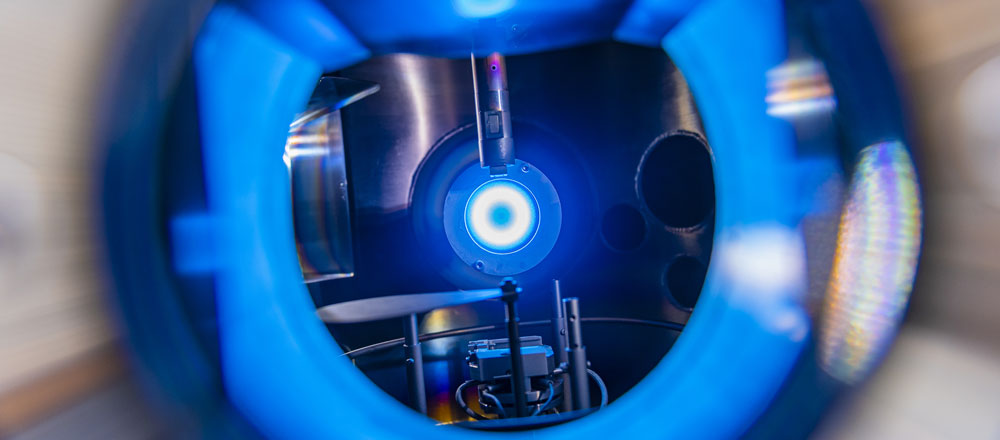

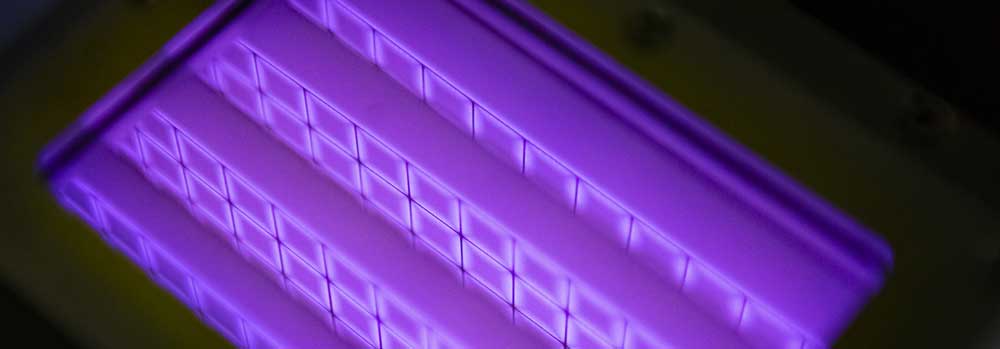
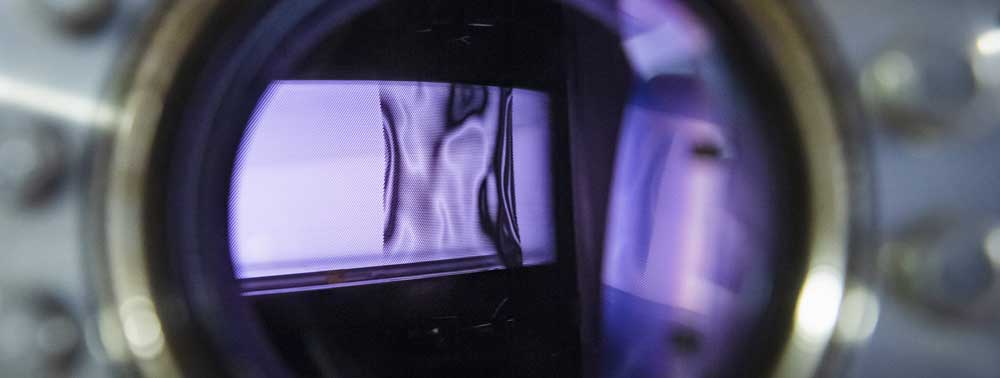





A5 - sDBDSurface Streamer PropagationTime-resolved electron impact excitation rates showing |
Project A3 - Excitation Transfer
Non-equilibrium excitation of CO2 in an atmospheric pressure helium plasma jet
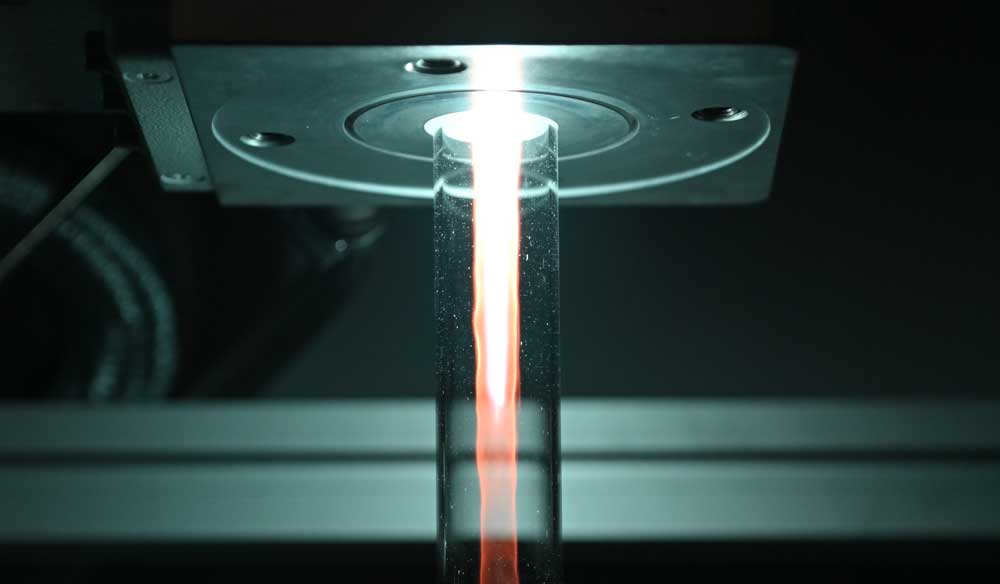
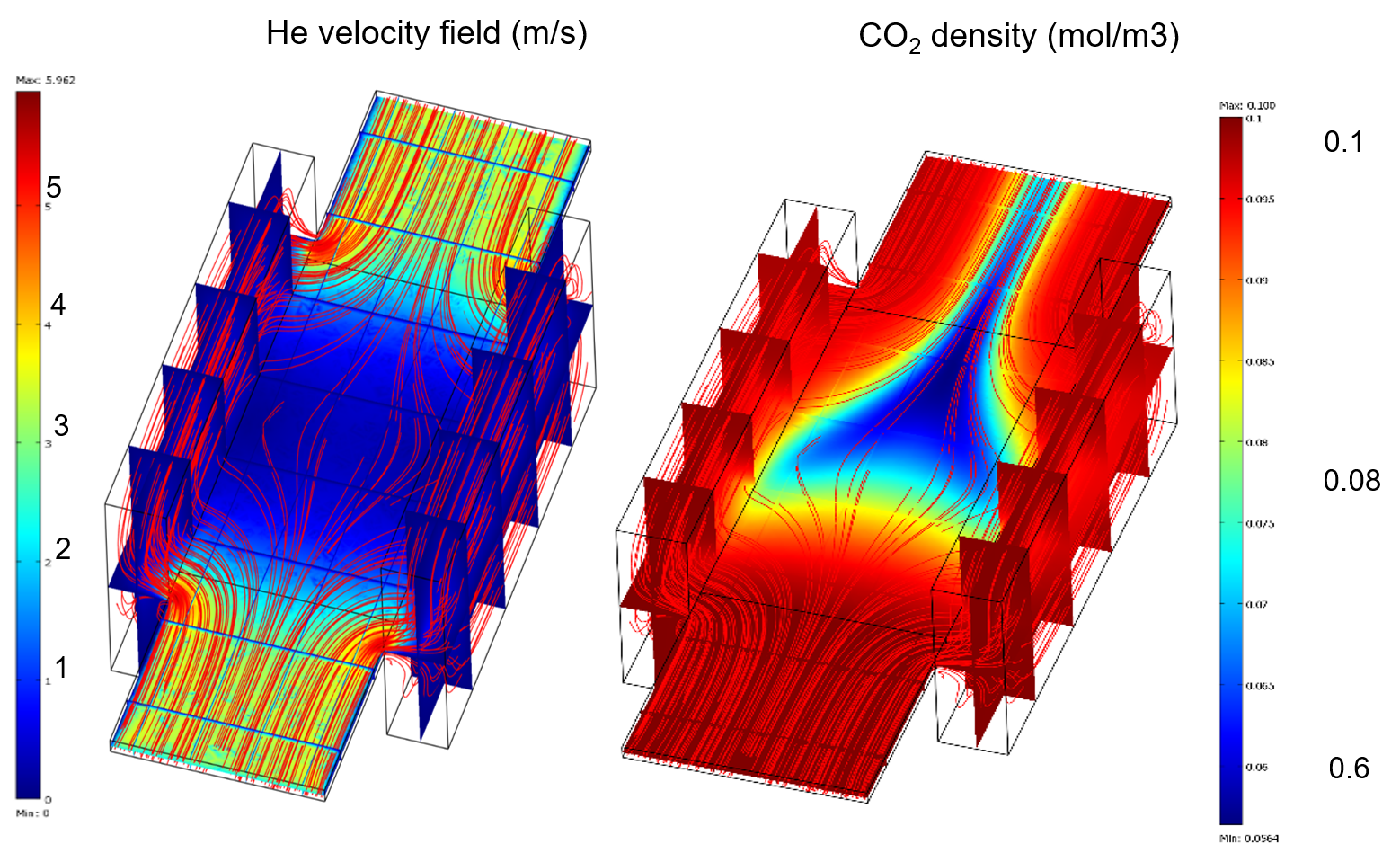
First results on the non-equilibrium excitation and dissociation of CO2 in an atmospheric pressure helium RF plasma jet. The objective of the project A3 in the SFB 1316 and the BMBF project Carbon2Chem is the separation of plasma and surface chemistry studied for the example of CO2 plasma excitation admixed to the noble gas within the plasma jet. This method offers the possibility to control the gas temperature of the feed gas as well as the molecule excitation by low energy electrons or by Penning collisions with the excited noble gas atoms or dimers. The plasma jet is driven with varying absorbed plasma power and admixture levels of CO2 . The excitation of CO2 is monitored by in-situ set-up of Fourier-Transform Infrared Spectroscopy. Concetrations of CO2 and the produced CO are analysed. Furthermore, the vibrational and rotational temperatures of the possible degrees of freedom of the measured molecules are determined.
The gas feed of the atmospheric pressure plasma jet was helium, because of the large mass difference and, there- fore, poor momentum transfer to CO2. This results in the smallest collisional quenching of all noble gases. The plane parallel plasma jet is driven with RF. These kind of plasma source is already very well investigated in respect to their plasma physics and chemistry for different gas mixtures of noble gases and molecules.
The main result of this work is the clear non-equilibrium excitation of CO2 and CO. In detail, the rotational tem- perature of CO is below 400 K and, in contrast to this, the vibrational temperature reached values up to 1600 K, and the temperature of the excitation of the asymmetric vibration of CO2 is about 700 K. The impact of variable plasma power and admixture of CO2 to the He gas flow is rather weak. It is assumed that the vibrational and rotational excitation of CO mainly originates from the dis- sociation reaction either by direct electron impact of CO2 or by Penning dissociation between CO2 and excited helium metastables. From this electronic energy transfer to CO2, highly vibrational excited CO molecules are pro duced by dissociation.
The non-equilibrium is due to the nature of excitation of molecules by collisions with electrons with energies larger than 7 eV at the oscillating sheath edges and Penning collisions with excited heilum atoms. The low rotational gas temperature is explained by the helium plasma gas which acts as a buffer.
This non-equilibrium character offers more investigations within the field of plasma catalysis, through which the reaction rate of a desired catalytic reaction is supported. Moreover, it is important to ensure the en- hancement of the reaction rate through the impact of excited molecules and not due to an unintentional heating of the catalyst surface by the plasma itself.
In the future, the experiments will be extended to other gas mixtures and the impact of catalytically active surfaces will be explored.
Projekt A3 - Anregungstransfer
Nicht-Gleichgewichts-Anregung von CO2 in einem Atmosphärendruck-Helium-Plasmastrahl
Erste Ergebnisse zur Nicht-Gleichgewichts-Anregung und Dissoziation von CO2 in einem Atmosphärendruck-Helium-HF-Plasmastrahl. Ziel des Projektes A3 im SFB 1316 und des BMBF-Projektes Carbon2Chem ist die Trennung von Plasma- und Oberflächenchemie, die am Beispiel einer dem Edelgas beigemischten CO2-Plasmaanregung innerhalb des Plasmastrahls untersucht wird. Diese Methode bietet die Möglichkeit, sowohl die Gastemperatur des Feedgases als auch die Molekülanregung durch niederenergetische Elektronen oder durch Penning-Kollisionen mit den angeregten Edelgasatomen oder Dimeren zu steuern. Der Plasmastrahl wird mit unterschiedlicher absorbierter Plasmaleistung und Beimischung von CO2 betrieben. Die Anregung des CO2 wird durch in-situ-Aufbau der Fourier-Transform-Infrarotspektroskopie überwacht. Die Konzentrationen von CO2 und dem erzeugten CO werden analysiert. Weiterhin werden die Schwingungs- und Rotationstemperaturen der möglichen Freiheitsgrade der gemessenen Moleküle bestimmt.
Die Gaszufuhr des Atmosphärendruck-Plasmastrahls war Helium, wegen des großen Massenunterschieds und des damit verbundenen schlechten Impulsübergangs auf CO2. Daraus resultiert das geringste kollisionelle Quenchen aller Edelgase. Der planparallele Plasmastrahl wird mit RF betrieben. Diese Art der Plasmaquelle ist hinsichtlich ihrer Plasmaphysik und -chemie für verschiedene Gasgemische aus Edelgasen und Molekülen bereits sehr gut untersucht.
Das Hauptergebnis dieser Arbeit ist die deutliche Nicht-Gleichgewichtsanregung von CO2 und CO. Im Detail liegt die Rotationstemperatur von CO unter 400 K und im Gegensatz dazu erreicht die Schwingungstemperatur Werte bis zu 1600 K, und die Temperatur der Anregung der asymmetrischen Schwingung von CO2 liegt bei etwa 700 K. Der Einfluss der variablen Plasmaleistung und der Beimischung von CO2 zum He-Gasstrom ist eher schwach. Es wird angenommen, dass die Schwingungs- und Rotationsanregung von CO hauptsächlich aus der Zerfallsreaktion stammt, entweder durch direkten Elektronenstoß von CO2 oder durch Penning-Dissoziation zwischen CO2 und angeregten Helium-Metastabilen. Aus diesem elektronischen Energietransfer auf CO2 werden durch Dissoziation hoch schwingungsangeregte CO-Moleküle erzeugt.
Das Nicht-Gleichgewicht ist auf die Art der Anregung der Moleküle durch Kollisionen mit Elektronen mit Energien größer als 7 eV an den schwingenden Mantelkanten und Penning-Kollisionen mit angeregten Heliumatomen zurückzuführen. Die niedrige Temperatur des Rotationsgases wird durch das Helium-Plasmagas erklärt, das als Puffer wirkt.
Dieser Nicht-Gleichgewichtscharakter bietet weitere Untersuchungen im Bereich der Plasmakatalyse, durch die die Reaktionsgeschwindigkeit einer gewünschten katalytischen Reaktion unterstützt wird. Dabei ist es wichtig, dass die Erhöhung der Reaktionsgeschwindigkeit durch die Einwirkung angeregter Moleküle und nicht durch eine ungewollte Erwärmung der Katalysatoroberfläche durch das Plasma selbst erfolgt.
In Zukunft sollen die Experimente auf andere Gasgemische ausgeweitet und der Einfluss von katalytisch aktiven Oberflächen untersucht werden.
Projekt A7 - Katalyse
Katalytische Oxidation von Kohlenmonoxid mit kaliumdotierten Mangandioxid-Nanopartikeln, die durch Sprühtrocknung synthetisiert wurden
Eines der Hauptziele des SFB 1316 ist die Untersuchung und das Verständnis der komplexen Wechselwirkungen zwischen einem nichtthermischen Plasma und heterogenen Katalysatoren. Die ersten Ergebnisse des Projekts A7, die die thermokatalytische Oxidation von CO über MnO2-Katalysatoren beschreiben, wurden kürzlich in Emission Control Science and Technology veröffentlicht. Insbesondere wurde die Wirkung der eingebauten Alkaliionen K+ und Na+ auf die strukturellen Eigenschaften und die katalytische Leistung hervorgehoben, um Struktur-Aktivitäts-Korrelationen abzuleiten.
Die MnO2-Katalysatoren wurden durch ein halbkontinuierliches Sprühtrocknungsverfahren auf der Grundlage der Komproportionierungsreaktion von Mn(NO3)2 und KMnO4 synthetisiert. Die Lösungen beider Verbindungen wurden in einem Mikromischer kontinuierlich gemischt und die entstehende Suspension wurde durch Sprühtrocknung schnell abgeschreckt, um weiteres Partikelwachstum zu verhindern. Um die K+-Ionen durch Na+-Ionen auszutauschen, wurde bei der Synthese NaMnO4 anstelle von KMnO4 verwendet. Nach dem Waschen und Trocknen der Katalysatoren erhielt man ein feines braunes Pulver, das wie vorbereitet verwendet oder bei 450°C oder 500°C für 4 Stunden in synthetischer Luft kalziniert wurde.
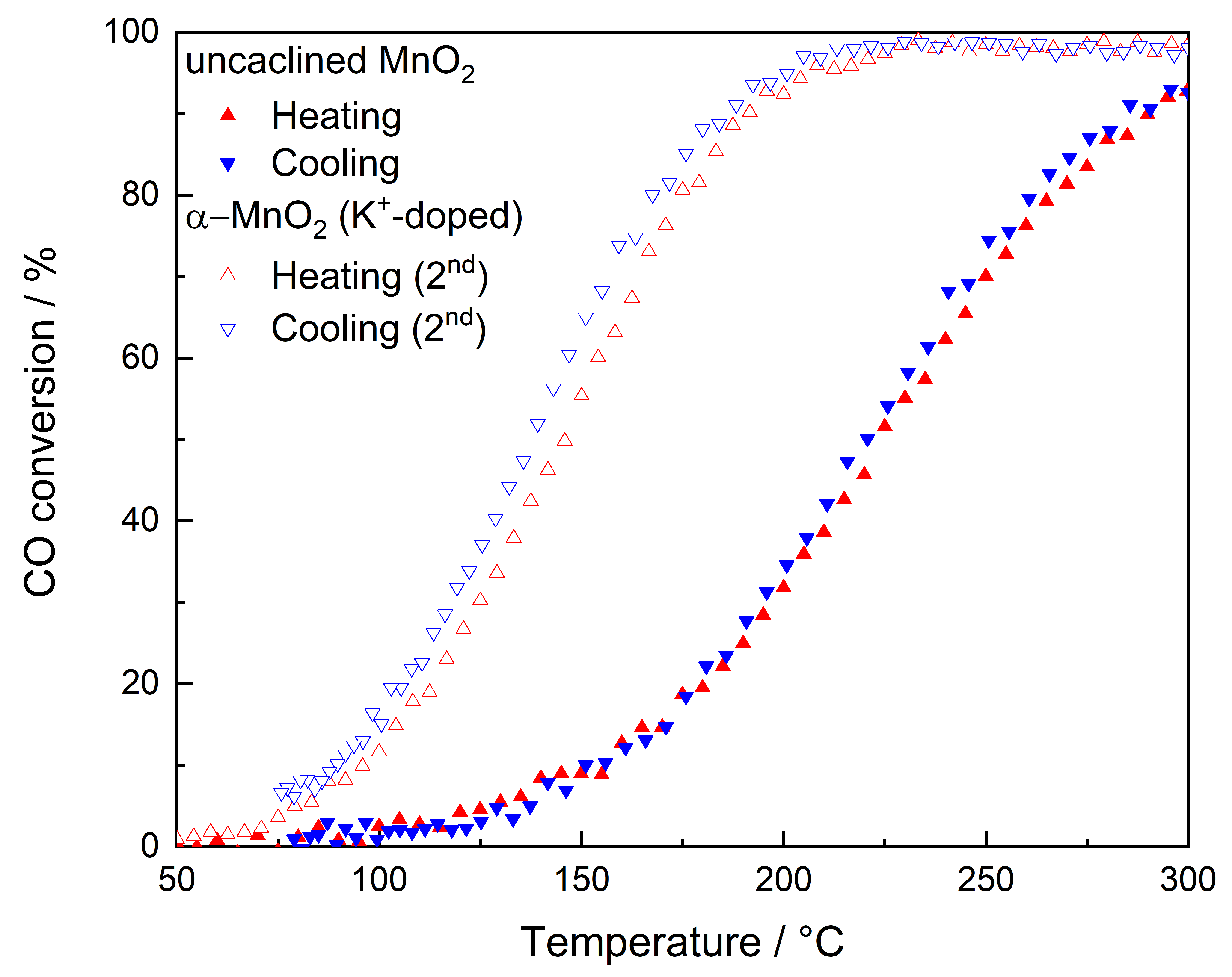
Wie die XPS-Ergebnisse und TPO-Profile zeigen, ist Mn (IV) die vorherrschende Oxidationsstufe aller Proben vor der Kalzinierung, was beweist, dass alle Katalysatoren aus MnO2 bestehen. Die XRD-Muster der nicht kalzinierten Katalysatoren zeigen jedoch eine röntgenamorphe Struktur, die eine genauere Phasenidentifizierung verhindert. Nach der Kalzinierung hängt die Phasenstruktur stark von der Art und Menge des eingebauten Alkaliions ab. Die Anwesenheit von K+ fördert die Bildung von kristallinem α-MnO2 und stabilisiert dessen Tunnelstruktur bis zu Temperaturen von 500°C. Geringere Mengen an K+ oder der Austausch mit Na+ führen zu weniger kristallinen Phasen nach der Kalzinierung bei 450°C und zur Bildung von kristallinem α-Mn2O3 nach der Kalzinierung bei 500°C.
Die katalytische CO-Oxidation wurde in einem Mikroreaktor durchgeführt, der mit einem nicht-dispersiven IR-Detektor ausgestattet war. Alle nicht kalzinierten Katalysatoren zeigten eine ähnliche katalytische Leistung, unabhängig von der Art oder Menge des eingebauten Alkaliions. Obwohl die spezifische Oberfläche des Katalysators während der Kalzinierung von 77 m2/g auf 37 m2/g abnahm, wies die reine alpha-MnO2-Phase eine überlegene katalytische Aktivität auf. Bei α-MnO2 wurde die Temperatur, bei der eine vollständige Umwandlung erreicht wurde, um mehr als 100 °C in Richtung niedrigerer Temperaturen verschoben. Im Gegensatz dazu zeigen die Katalysatoren, die alpha-Mn2O3 enthalten, eine ähnliche katalytische Aktivität wie die nicht kalzinierten Katalysatoren, was darauf hindeutet, dass nicht nur der höhere Kristallinitätsgrad, sondern auch die strukturellen Eigenschaften von α-MnO2 seine hohe katalytische Aktivität verursachen. Der Einbau von K+-Ionen ist erforderlich, um die Tunnelstruktur von α-MnO2 zu stabilisieren.
DFG
SFB 1316 granted
Non-equilibrium processes are the basis of a multitude of phenomena in nature such as transport, excitation of atoms and molecules and de-excitation and dissipation at surfaces. The non-equilibrium character of plasmas is especially pronounced due to the high energy density in these systems and the very selective excitation of, for example, only the electrons. If these plasmas are brought into contact with solids or liquids, the non-equilibrium character can be transferred to other states of matter. An excellent example are plasma chemistry processes that are directly coupled to catalytically active surfaces.
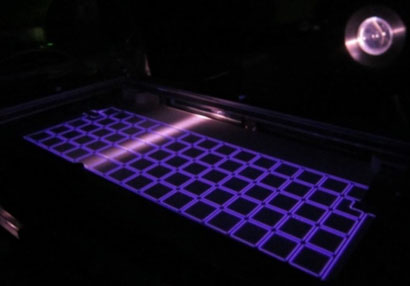 The use of non-equilibrium atmospheric pressure plasmas is most interesting since they can most easily be combined with standard chemical processes. The non-equilibrium character of these plasmas can be controlled by large gas flows or by short pulsed excitation assuring strong cooling mechanisms. Thereby, a huge variety of desired plasma chemistries or emission patterns can be adjusted following an empirical strategy. However, any further progress is hampered by the lack of a fundamental understanding of those discharges and their interaction with fluid and solid Interfaces.
The Collaborative Research Centre (CRC) 1316 “Transient atmospheric plasmas – from plasmas to liquids to solids” addresses these research questions by combining expertise in plasma physics, surface physics, chemistry, biotechnology, and engineering. This CRC focuses on transient atmospheric plasmas at varying spatial and temporal scales for the nanostructuring and activation of catalytic surfaces, for the coupling to catalysis and biocatalysis, as well as for electrochemical processes. Due to the strong interaction between these plasmas and the confining interfaces, special in-situ, real-time, and in-operando methods will be employed. The research program follows three consecutive phases with reaching a basic understanding at the beginning to the optimum integration of plasma and active surface, until the up-scaling of these plasmas. The CRC 1316 seeks optimal solutions for systems for energy conversion (solar fuels, CO2 harvesting, photocatalysis), to health (removal of volatile organic compounds from air streams), for biotechnology (plasma-driven biocatalysis), and for technical chemistry (bottom-up synthesis from small molecules to valuable chemicals).