






B5 - Plasma in liquidsBubble dynamicsGas bubble dynamics during Plasma Electrolytic Oxidation |
MGK Colloquium
Virtual MGK Colloquium
The scientific exchange among the CRC members and the group of Early Career Researcher occurred continuously during the three yearly project meetings and in the workshops organized by the CRC 1316 since it starting in 01/2018. However, it is very important that the ECR have also a platform to interact in a conference setting without the impact of their adviser to stimulate the discussions among the ECR. Instead, the CRC 1316 decided to organize an MGK Colloquium on its own by inviting the ECR from the CRC 1316 and from the SFB-TR 87. This meeting was organized by the ECRs J. Kuhfeld and P. Preissing in a virtual format on 21/04/2021. Prominent invited speakers at this event were Prof. A. Bogaerts (university Antwerp), Dr. S. Iseni (GREMI, Orléans) and Dr. T.L. Chng (LPP Paris). Beside presentations within a zoom meeting, virtual poster sessions were performed, enhancing the interaction between the ECR.
Anerkennung der Forschung des Projekts A5
Projekt A5 auf der vorderen Umschlaginnenseite von Plasma Processes and Polymers
In der aktuellen Ausgabe (April 2021) von Plasma Processes and Polymers wird auf der vorderen Umschlaginnenseite Arbeit aus dem Projekt A5 des SFB 1316 zum Thema "Positive und negative Streamer-Propagation in dielektrischen Volumen-Barriereentladungen mit planaren und porösen Elektroden" vorgestellt.
Die Wissenschaftler haben herausgefunden, dass sich die Entladungscharakteristik von negativen Oberflächen-Streamern deutlich von der von positiven Oberflächen-Streamern unterscheidet. Während sich negative Streamer entlang der dielektrischen Oberfläche entwickeln und sich so in viel kleinere dielektrische Poren ausbreiten können, entwickeln sich positive Streamer schwebend über dem Dielektrikum.
- Der Artikel zu den Forschungsergebnissen und die Umschlaginnenseite sind online frei zugänglich.
Honour of research of project A5
Project A5 on the Inside Front Cover of Plasma Processes and Polymers
The current issue (April 2021) of Plasma Processes and Polymers features work from project A5 of the CRC 1316 on the topic of "positive and negative streamer propagation in volume dielectric barrier discharges with planar and porous electrodes" on its inside front cover.
The scientists have found that the discharge characteristics of negative surface streamers differ significantly from those of positive surface streamers. While negative streamers develop along the dielectric surface, allowing them to propagate into much smaller dielectric pores, positive streamers floatingly develop above the dielectric.
- The article on the research findings and the Inside Front Cover are freely accessible online.
Project A7 - Catalysis
Catalytic carbon monoxide oxidation over potassium-doped manganese dioxide nanoparticles synthesized by spray drying
One of the major objectives of the CRC 1316 is the investigation and understanding of the complex interactions between a non-thermal plasma and heterogeneous catalysts. The first results of project A7 describing the thermocatalytic oxidation of CO over MnO2 catalysts were recently published in Emission Control Science and Technology. Particularly, the effect of the incorporated alkali ions on K+ and Na+ on the structural properties and the catalytic performance was emphasized to derive structure-activity correlations.
The MnO2 catalysts were synthesized by a semi-continuous spray drying procedure based on the comproportionation reaction of Mn(NO3)2 and KMnO4. Solutions of both compounds were continuously mixed in a micromixer and the emerging suspension was rapidly quenched by spray drying to inhibit further particle growth. In order to exchange the K+ ions by Na+ ions, NaMnO4 was used instead of KMnO4 during the synthesis. After washing and drying of the catalysts a fine brown powder was obtained, which was used as prepared or calcined at 450°C or 500°C for 4 h in synthetic air.
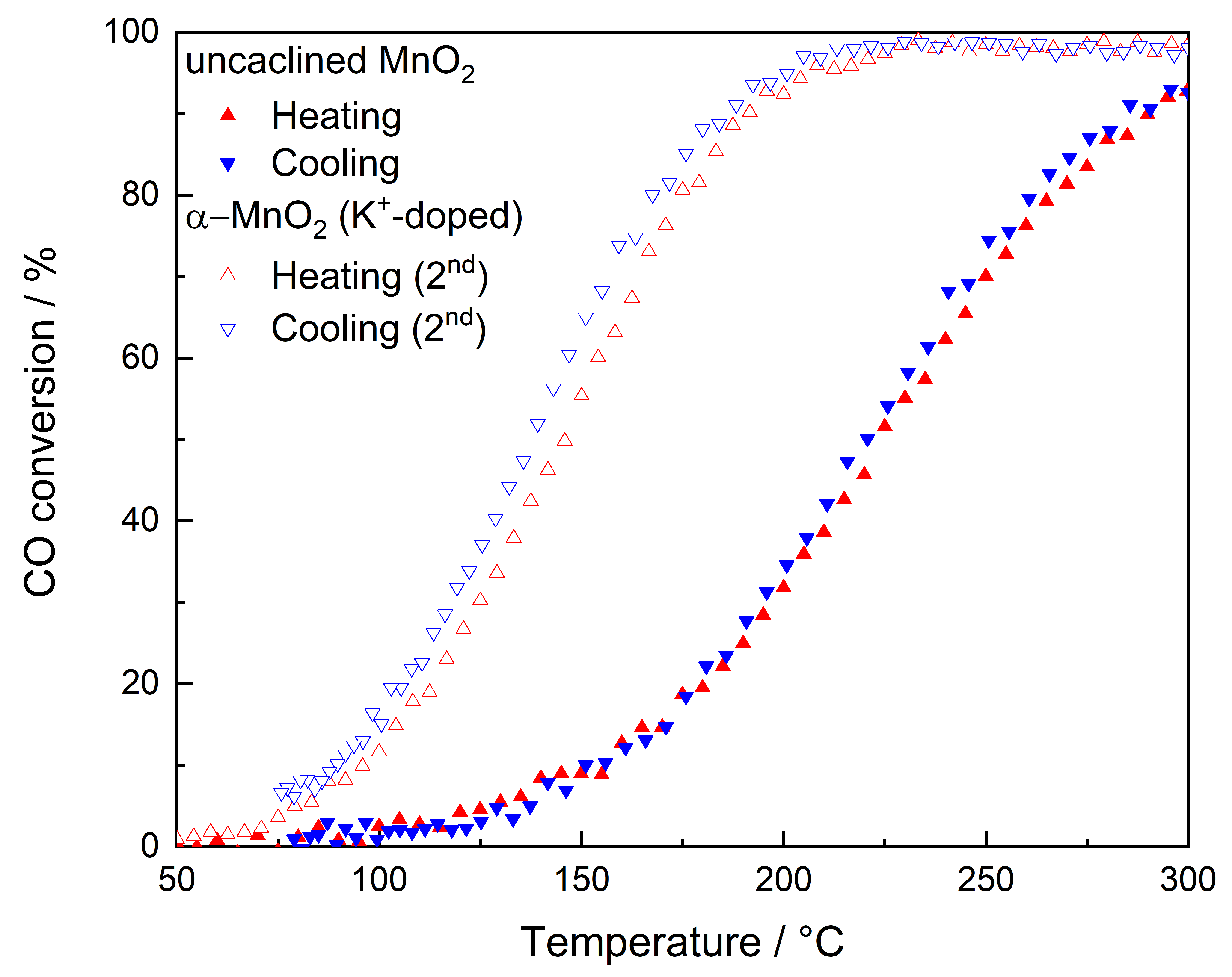
As shown by the XPS results and TPO profiles Mn (IV) is the predominant oxidation state of all samples prior to calcination proving that all catalysts consist of MnO2. However, the XRD patterns of the uncalcined catalysts reveal an X-ray amorphous structure preventing a more in-depth phase identification. After calcination the phase structure strongly depends on the type and amount of the incorporated alkali ion. The presence of K+ promotes the formation of crystalline alpha-MnO2 and stabilizes its tunnel structure up to temperatures of 500°C. Lower amounts of K+ or the exchange with Na+ lead to less crystalline phases after calcination at 450°C and to the formation of crystalline alpha-Mn2O3 after calcination at 500°C.
The catalytic CO oxidation was performed in a microreactor set up equipped with a non-dispersive IR detector. All uncalcined catalysts revealed a similar catalytic performance regardless of the type or amount of the incorporated alkali ion. Even though the specific surface area of the catalyst decreased from 77 m2/g to 37 m2/g during calcination the pure alpha-MnO2 phase exhibited a superior catalytic activity. Over alpha-MnO2 the temperature at which full conversion was achieved was shifted towards lower temperatures by more than 100°C. In contrast the catalyst containing alpha-Mn2O3 show a catalytic activity similar to the uncalcined catalysts indicating that not only the higher degree of crystallinity but also the structural properties of alpha-MnO2 cause its high catalytic activity. The incorporation of K+ ions is required to stabilize the tunnel structure of alpha-MnO2