





A5 - sDBDHe emissionTime-resolved electron impact excitation rate from the ground state into He I |
ÖFFENTLICHKEITSARBEIT
Plasmen für alle
Zahlreiche Alltagstechnologien würde es ohne Plasmen nicht geben. Die Teams der Sonderforschungsbereiche wollen das Wissen über ihre Relevanz in die Öffentlichkeit tragen.
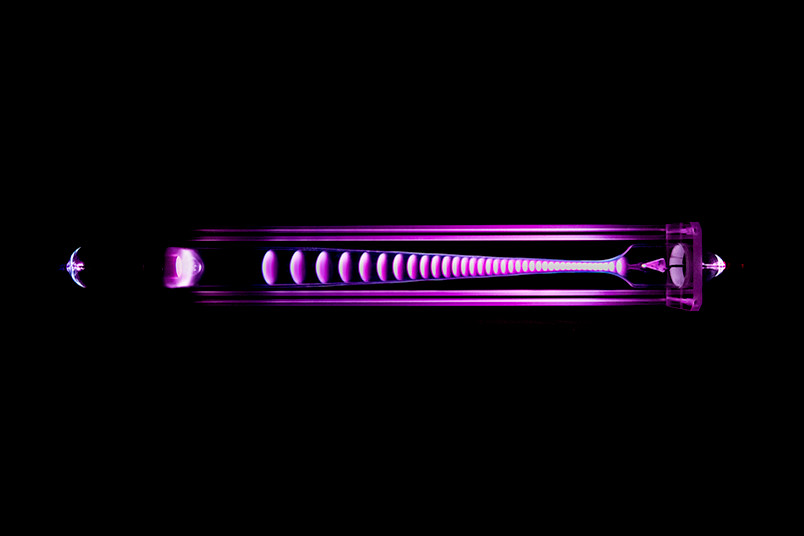
Mit dem Plasmatruck zur Schule
Die Plasmaforscherinnen und -forscher der RUB engagieren sich seit vielen Jahren, um Schülerinnen und Schülern verschiedener Jahrgangsstufen Plasmen näherzubringen. „Im Physikunterricht werden zwar teils Experimente gemacht, bei denen Plasmen im Einsatz sind, aber das Wort Plasma taucht im Lehrplan gar nicht auf“, erklärt Science-Managerin Dr. Marina Prenzel. Um Schülerinnen und Schüler der Oberstufe mit dem Konzept eines Plasmas vertraut zu machen, hat das SFB-Team in Zusammenarbeit mit Physik- Didaktikern um Prof. Dr. Heiko Krabbe verschiedene in Boxen verstaubare Plasma-Experimente konstruiert, die handlich im Kleinbus transportiert werden können. Mit ihnen können die Forschenden abwechslungsreiche 90-minütige Workshops in Oberstufenklassen abhalten, bei denen Schülerinnen und Schüler selbst experimentieren und verschiedene Anwendungsbereiche von Plasmen kennenlernen können. „So wollen wir ein Bewusstsein dafür schaffen, dass Plasmen extrem wichtig für viele unserer heutigen Technologien sind“, sagt Marina Prenzel.
Schüler und Schülerinnen bewerten Forschungsprojekte
Nicht nur, was ein Plasma eigentlich ist und wo es zum Einsatz kommt, sollen Schülerinnen und Schüler erfahren können. Das SFB-Team baut derzeit zusammen mit der Physik-Didaktik auch ein Projekt auf, das die Bewertungskompetenz der Jugendlichen und jungen Erwachsenen fördern soll. Hierbei sollen Schülerinnen und Schüler Einblicke in verschiedene Plasmaforschungsvorhaben bekommen und bewerten, welche dieser Projekte sie fördern würden. Ziel ist, dabei auch zu vermitteln, wie Plasmen dazu beitragen können, die Herausforderungen der Klimaerwärmung zu meistern.
Über 20 Jahre Plasma Summer School
Seit über 20 Jahren organisieren Plasmaforscherinnen und -forscher der RUB einmal im Jahr eine internationale Summer School für Master-Studierende und Promovierende. Sie ging ursprünglich aus einem europäischen Erasmus-Projekt hervor, das die Technische Universität Eindhoven federführend eingeworben hatte. Als die Fördergelder im Jahr 2000 ausliefen, engagierte sich das RUB-Team für die Fortsetzung. „Die Schule ist eigentlich immer überbucht“, erzählt Mitorganisator Dr. Marc Böke. Die jährlich 80 bis 90 Teilnehmerinnen und Teilnehmer sowie die Vortragenden kommen aus der ganzen Welt. Ziel der siebentägigen Veranstaltung ist es, ihnen Einblicke in alle wesentlichen technisch relevanten Plasmen und zugleich die Vernetzung untereinander sowie mit etablierten Forschenden des Fachs zu ermöglichen. „Einige der ehemaligen Teilnehmenden leiten mittlerweile selbst Plasmalabore“, erzählt Böke. Das RUB-Team hofft, das erfolgreiche Format trotz der Coronasituation bald wieder in Präsenz fortführen zu können.
übernommen von Julia Weiler, RUB
PUBLIC RELATIONS
Plasmas for all
A great many everyday technologies would not exist without plasmas. The teams of the Collaborative Research Centres want to share knowledge about their relevance with the public.
Driving the plasma van to school
For many years, the plasma researchers at RUB have been committed to introducing plasmas to school students in different year groups. “Physics teachers sometimes conduct experiments that involve plasmas, but the word plasma doesn’t even appear in the curriculum,” explains Science Manager Dr. Marina Prenzel. In order to familiarise secondary school students with the concept of a plasma, the SFB team, in cooperation with Professor Heiko Krabbe and other physics didactics experts, has constructed various plasma experiments that can be stowed away in boxes and handily transported in a minibus. The researchers use them for interesting 90-minute workshops in sixth-form classes, where students can do their own experiments and learn about different applications of plasmas. “This is how we want to create awareness that plasmas are extremely important for many of our current technologies,” says Prenzel.
Students evaluate research projects
Students should not only be given the chance to learn what a plasma actually is and where it is used. Rather, the SFB team is also currently setting up a project in collaboration with the physics didactics department that aims at promoting the evaluation skills of adolescents and young adults. Here, students are to gain insights into various plasma research projects and evaluate which of these projects they would support. Another goal is to convey the significance of plasmas for the challenges of global warming.
More than 20 years of plasma summer school
For more than 20 years, plasma researchers at RUB have been organising an annual international summer school for Master’s students and doctoral candidates. It originally emerged from a European Erasmus project, acquired under the auspices of the Eindhoven University of Technology. When the funding ran out in 2000, the RUB team dedicated itself to continuing it. “The school is practically always overbooked,” says co-organiser Dr. Marc Böke. The 80 to 90 participants each year and the lecturers come from all over the world. The aim of the seven-day school is to give them insights into all the major technically relevant plasmas and, at the same time, to enable them to network with each other and with established researchers in the field. “Some of the former participants are now themselves running plasma labs,” says Böke. The RUB team hopes to resume the successful format soon, despite the coronavirus situation.
adapted from Julia Weiler, RUB
DIAGNOSTICS
Plasmas as chemistry labs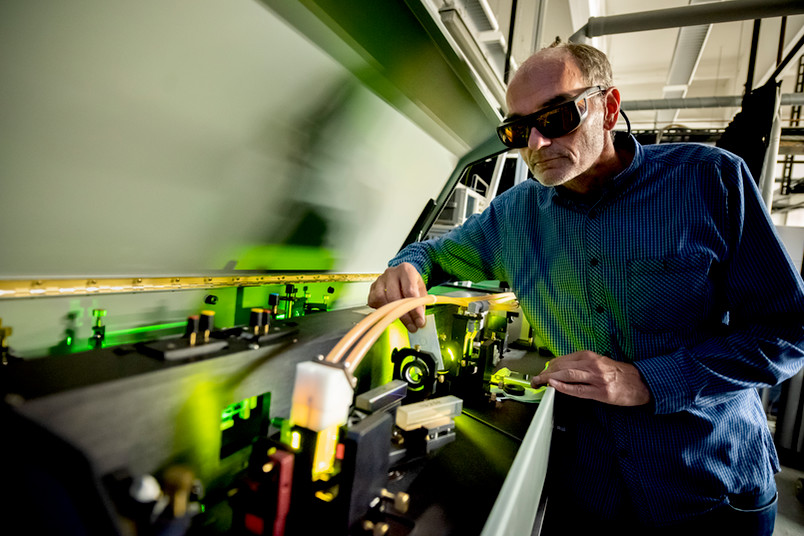
The smaller a plasma, the larger the experimental setup needed to study it. It is worth the effort, because the reaction conditions found in cubic-millimetre-sized plasmas are very much unique. Even though plasmas at atmospheric pressure are often only a few cubic millimetres in size, they pack quite a punch. This is because special non-equilibrium states can be set up in them, which facilitate physical and chemical processes that are not possible in any other environment. The plasma thus becomes a special kind of laboratory, where atoms and molecules can be excited without their surroundings heating up. “Such excitations could theoretically also be generated in a gas, but to do so we would have to heat it to several thousand degrees Kelvin. As a result, the molecules would decompose,” explains Professor Uwe Czarnetzki, Head of the Chair of Plasma and Atomic Physics at the Faculty of Physics and Astronomy. For many years, he and his team have been developing methods to explore the processes inside plasmas and to characterise the plasmas. Plasmas boast a unique feature: electric fields can be used to supply energy to the electrons in the plasma; the electrons in turn interact with molecules such as nitrogen or carbon dioxide while transferring the energy to them. The molecules are excited, and this happens without the environment heating up in the process, as would be the case in a gas. The molecules that are excited to vibrate have a much higher reactivity than those in the ground state. Plasma can therefore change chemistry or even enable certain chemical processes in the first place. Consequently, plasma provides basic researchers with a unique opportunity to study the excitation of molecules and the associated chemistry beyond thermodynamic equilibrium. Uwe Czarnetzki is therefore primarily interested in the vibrational states of molecules in plasmas.
Forschung
Plasmen als Chemielabor
e kleiner ein Plasma, desto größer ist oft der Messaufbau, um es zu untersuchen. Der Aufwand lohnt sich, denn in Kubik-Millimeter kleinen Plasmen finden sich Reaktionsbedingungen wie nirgendwo sonst. Plasmen mit Atmosphärendruck sind oft nur wenige Kubik-Millimeter groß – aber trotzdem haben sie es in sich. Denn in ihnen lassen sich spezielle Nichtgleichgewichtszustände einstellen, die physikalische und chemische Prozesse erlauben, welche in keiner anderen Umgebung möglich sind. So wird das Plasma zu einer Art Speziallabor: Atome und Moleküle können darin angeregt werden, ohne dass sich ihre Umgebung erhitzt. „Solche Anregungen könnte man theoretisch auch in einem Gas erzeugen, aber dazu müsste man es auf mehrere tausend Grad Kelvin erhitzen – dann würden sich die Moleküle allerdings zersetzen“, erklärt Prof. Dr. Uwe Czarnetzki, Leiter des Lehrstuhls für Plasma- und Atomphysik an der Fakultät für Physik und Astronomie. Seit vielen Jahren entwickelt er mit seinem Team Verfahren, um die Vorgänge im Inneren von Plasmen zu untersuchen und die Plasmen zu charakterisieren. Das Besondere an Plasmen: Über elektrische Felder kann den Elektronen im Plasma Energie zugeführt werden; die Elektronen wiederum wechselwirken mit Molekülen wie Stickstoff oder Kohlendioxid und geben die Energie dabei an diese ab – die Moleküle werden angeregt, und zwar, ohne dass sich die Umgebung dabei erhitzt, wie es in einem Gas der Fall wäre. Die zu Schwingungen angeregten Moleküle besitzen wiederum eine weit höhere Reaktivität als solche im Grundzustand. Man kann also durch das Plasma die Chemie verändern beziehungsweise gewisse chemische Abläufe überhaupt erst ermöglichen. Das Plasma bietet Grundlagenforscherinnen und -forschern somit eine einzigartige Möglichkeit, um die Anregung von Molekülen und die damit verbundene Chemie fernab des thermodynamischen Gleichgewichts zu untersuchen. Uwe Czarnetzki interessiert sich daher vor allem für die Schwingungszustände von Molekülen in Plasmen.