
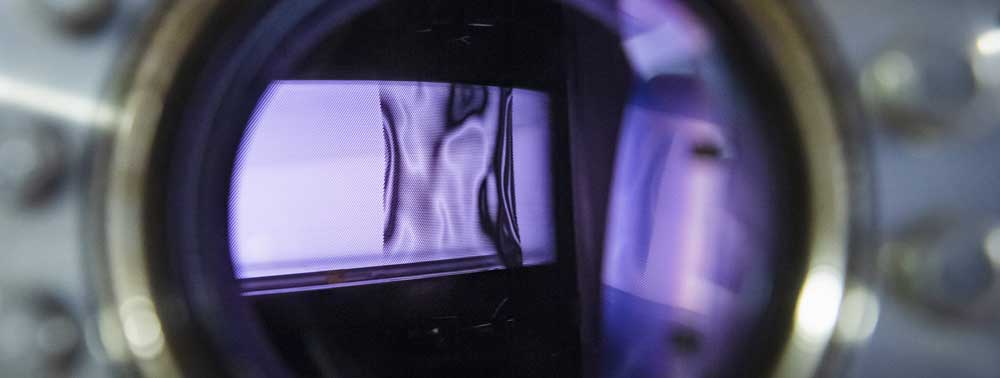
A7 - sDBDSchlierenSchlieren imaging of the start phase of plasma-induced fluid flow in a |
Outreach
CRC 1316 is now on Twitter
The Research Department Plasmas with Complex Interactions (RDPCI) is now on Twitter. If you would like to receive updates on cooperation, progress made in the projects and events, we will now also present these to you via @RDPlasma. The account will cover both information on the CRC 1316 and SFB-TR 87 as well as other projects included in the RDCPI.
Outreach
Students' project week 2021
 After a break of two years, the students’ project week took place in person at Ruhr University again. In cooperation with the zdi Netzwerk, students grade 8 and 9 could participate in either “World of Plasmas” and “Physics in Medicine” during the first week of the autumn break. During the project week, students gained an insight into different laboratories and could work on a small research project using different diagnostics and apertures to present their findings in a poster session at the end of the week. Next to the research projects, the students visited the Planetarium Bochum, attended a lecture by Prof. Hildebrandt on the weight of the universe and had a session with alumni to ask questions on possible career paths with a degree in physics. The week ended with a common outdoor pizza lunch. The next project week will take place during the first week of the Easter holiday 2022, offering three workshops to girls in grade 8, 9 and 10.
Awards
Dissertationspreis der Fakultät für Physik und Astronomie für Dr. Katharina Grosse (Projekt B7)
Die Erzeugung von Plasmen in Flüssigkeiten ist für Anwendungen wie die Elektrolyse, Wasserreinigung oder Medizin wichtig, eröffnet aber auch eine Reihe von sehr grundlegenden Fragen. Diese Plasmen werden durch kurze Spannungspulse im Bereich von vielen Kilovolt und wenigen Nanosekunden Dauer erzeugt, die an einer in Wasser untergetauchten Wolframspitze angelegt werden. Um das Verständnis der Zündung dieser Plasmen herrscht eine rege Debatte, da die Elektronenvervielfältigung bei der Plasmazündung entweder innerhalb kleiner Nanovoids, kleinen Frakturen im Wasser, oder als Elektronenlawine im Wasser selbst postuliert wird. In beiden Fällen spielt Feldemission an Grenzflächen oder Feldionisation von Wassermolekülen eine entscheidende Rolle. Frau Dr. Grosse hat die ganze Dynamik diese Plasmen von der Zündung bis zum Afterglow mittels zeitlich aufgelöster Emissionsspektroskopie untersucht und mit Modellierungen der Emission und der Flüssigkeitsdynamik verglichen. Dabei zeigte sie, dass das breite Kontinuum durch Schwarzkörperstrahlung erzeugt wird, die mit einer Temperatur von 7000 K genau der Temperatur von kochendem Wolfram entspricht. Aus der Starkverbreiterung der Balmerlinien der Wasserstoffatome lassen sich Elektronendichten von mehreren 1025 m-3 ableiten. Weiterhin beobachtet man eine starke Selbstabsorption von Licht aus der Region des Plasmakanals während das Licht von der laufenden Ionisationsfront keine Selbstabsorption zeigt. Daraus lässt sich ableiten, dass das Plasma direkt durch Wasser läuft und nicht innerhalb von Nanovoids gebildet wird. Damit dominiert Feldemission und Feldionisation. Nach diesem ersten Plasmapuls, führt die hohe Leistungsdichte zu dem Phasenübergang von Wasser zu Wasserdampf und Bläschenbildung innerhalb der ersten Mikrosekunde. Der hohe Druck im Bereich von GPa bewirkt eine Ausdehnung des Kavitationsbläschens und die Erzeugung einer Schallwelle, die sich in der Flüssigkeit ausbreitet. Dies konnte mittels Schattenaufnahmen direkt beobachtet werden. Insbesondere erreicht die Schallgeschwindigkeit mehrere 1000 Meter pro Sekunde, was auf den sehr hohen Druck zu Beginn der Entladung hindeutet. Auf der Basis dieser Messung hat Frau Dr. Grosse das Verständnis dieser Plasmen sehr wesentlich erweitert.
Awards
Heraeus Dissertation Award of the Faculty of Physics and Astronomy at RUB for Dr. Katharina Grosse (project B7)
The generation of plasmas in liquids is important for applications such as electrolysis, water purification or medicine, but also opens up a number of very fundamental questions. These plasmas are generated by short voltage pulses in the range of many kilovolts and a few nanoseconds in duration applied to a tungsten tip submerged in water. There is a lively debate around understanding the ignition of these plasmas, as electron multiplication during plasma ignition is postulated to occur either within small nanovoids, small fractures in the water, or as an electron avalanche in the water itself. In both cases, field emission at interfaces or field ionization of water molecules plays a crucial role. Dr. Grosse studied the whole dynamics of these plasmas from ignition to afterglow using time-resolved emission spectroscopy and compared it with modeling of emission and fluid dynamics. It showed that the broad continuum is produced by blackbody radiation, with a temperature of 7000 K, exactly equal to that of boiling tungsten. Electron densities of several 1025 m-3 can be derived from the strong broadening of the Balmer lines of the hydrogen atoms. Furthermore, a strong self-absorption of light from the region of the plasma channel is observed while light from the running ionization front shows no self-absorption. From this it can be deduced that the plasma runs directly through water and is not formed within nanovoids. Thus, field emission and field ionization dominate. After this first plasma pulse, the high power density leads to the phase transition from water to water vapor and bubble formation within the first microsecond. The high pressure in the range of GPa causes an expansion of the cavitation bubble and the generation of a sound wave propagating in the liquid. This could be directly observed using shadowgraphs. In particular, the speed of sound reaches several 1000 meters per second, indicating the very high pressure at the beginning of the discharge. Based on this measurement, Dr. Grosse has very significantly extended the understanding of these plasmas.