A5 - sDBDSurface Streamer PropagationTime-resolved electron impact excitation rates showing |
JSPS Core-to-core program
Patrick Hermanns visit research group in Osaka
I have visited Hamaguchi Laboratories at Osaka University in Japan for 3 months. The lab exchange was funded partially by the CRC-1316 and the JSPS Core-to-core program. The group of Prof. Satoshi Hamaguchi developed a reaction-diffusion-convection simulation for the generation and transport of chemical species in water, introduced by atmospheric-pressure plasma.
During my stay I worked on a multiphase fluid model. The typical flow field of a turbulent atmospheric-pressure plasma jet in direct vicinity of a liquid was modelled by solving a k-epsilon turbulence model. A Volume-of-Fluid (VOF) method was applied for the coupled flow of gaseous and liquid phase. The simulations agree very well with experimental results in the literature. The results from the fluid flow simulations were integrated into the reaction-diffusion-convection equations to evaluate the influence of different flow regimes on the generation and transport of chemical species in the liquid.
In Bochum University, I am working as a PhD-Student within project “B5: 2D-plasma-liquid-solid interfaces – plasma electrolytic oxidation“. The results generated can be useful for this project in regards of chemical species generation inside of liquids. In addition, the fluid flow model is interesting for other groups working with atmospheric-pressure plasmas (e.g. B2: “Self-organization of sub-µm surface structures stimulated by microplasma generated reactive species and short-pulsed laser irradiation“). Summarizing I can say, that I had a very pleasant stay in Osaka, that I personally enjoyed a lot. The cooperation with Hamaguchi Laboratories were very fruitful and everyone was very kind during my stay.
JSPS Core-to-core program
Abdulkadir Yayci visits Japanese colleagues
From October to December 2019, I was able to join the lab of Prof. Satoshi Hamaguchi at the Center for Atomic and Molecular Technologies in Osaka, Japan. My field of research is applied microbiology and my focus is on biocatalytic reactions with non-thermal plasmas. Using numerical simulations, I studied the propagation of plasma-induced reactive species in liquids to gain an insight on the depth of penetration and concentration of these species. This knowledge will help to understand the interaction between plasmas and enzymes that are studied in project B8 of the CRC 1316, specifically to protect the enzymes from inactivation and to drive biocatalysis. The research stay in Japan was very helpful to depen my knowledge for my main research question.
MGK
International School on Low Temperature Plasma Physics: Basics and Applications 2019
The traditional summer school on low temperature plasma physics was held in the Physikzentrum in Bad Honnef and from Octobre 5th, 2019 until Octobre 12th, 2019. The PIs contributed to the lecturing program and new PhD and master students of the CRC1316 attended the school.
GUESTS EP2
Erasmus student joins CRC 1316 project
Between March 25th and July 19th, 2019 the Erasmus student Roel Michiels visits the research group EP2 of Prof. von Keudell at Ruhr University Bochum. He joins project A3 from the CRC 1316 "Excitation transfer between molecules in transient atmospheric pressure plasmas and its impact on plasma chemistry".
Roel Michiels is associated with the group of Annemie Bogaerts from the Department of Chemistry at the University of Antwerp. He finished his Bachelor thesis last year and prepares now for his Master degree. The topic of his Master thesis is micro kinteic modelling of plasma catalysis. The modelling is done via Density functional theory (DFT) and Molecular Dynamics (MD).
Together with Theresa Urbanietz, Christoph Stewig, and Steffen Schüttler he tries to gain experience in experimental work in Bochum. His work here focuses on the measurement as well as on the analysis of FTIR spectra gained in the project.
MGK
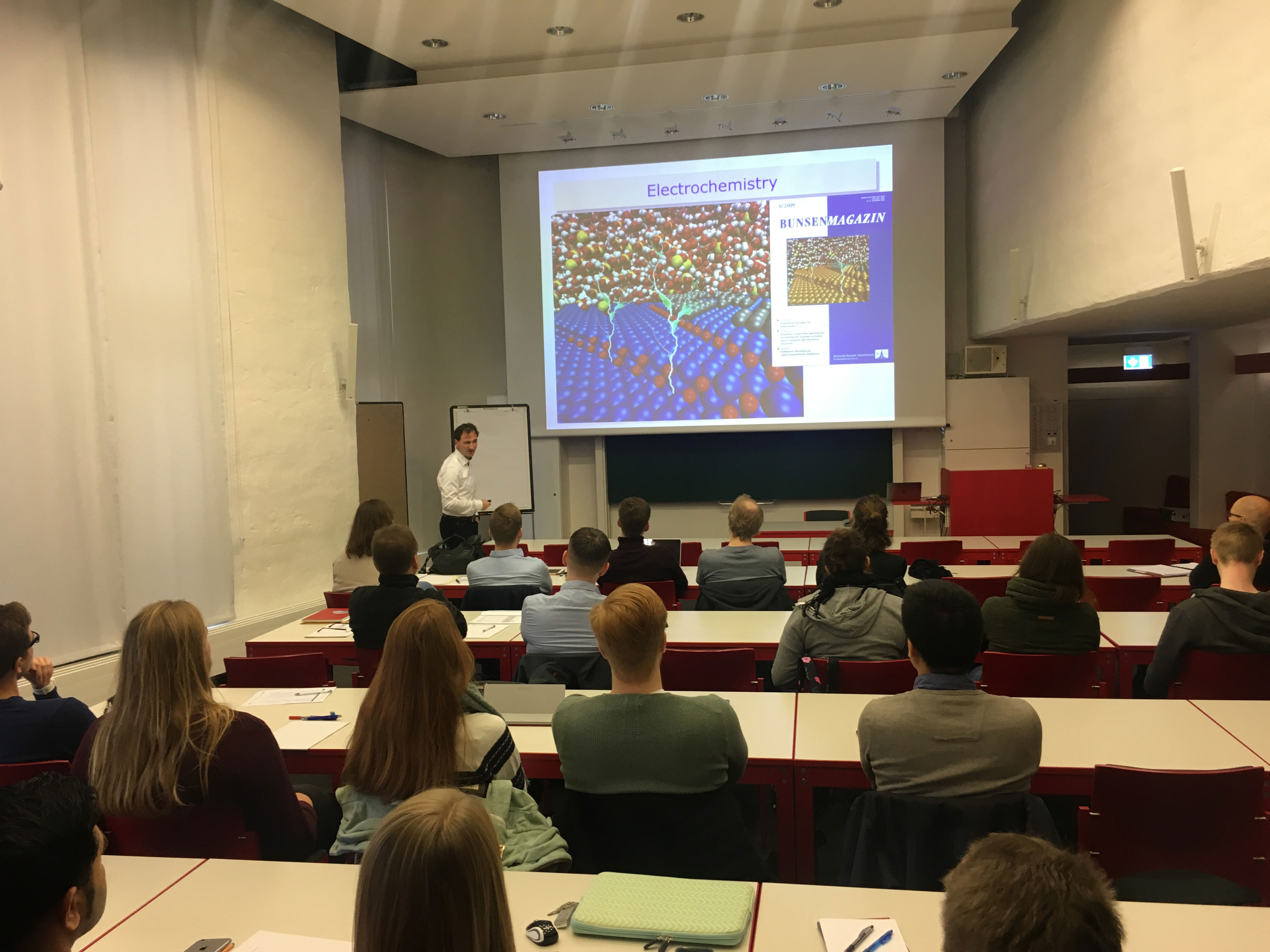
Workshop Electrochemistry
The team of the PI Timo Jacob at University Ulm organized a workshop on the basics and applications of electrochemistry. The similarity to plasma science is striking, with the Debye-Hückel theory being at the core of both systems - plasmas and electrochemistry in the electrolyte. Nevertheless, significant differences exist because the boundary layer in the electrolyte in front of an electrode is much more complex than in a plasma sheath region. The workshop topics ranged from a general introduction to electrochemistry to methods to electro catalysis up to the theoretical modeling of electrochemical processes.