

A5 - sDBDHe emissionTime-resolved electron impact excitation rate from the ground state into He I |
Interantionalisierung
ICOPS-Konferenz in Seattle
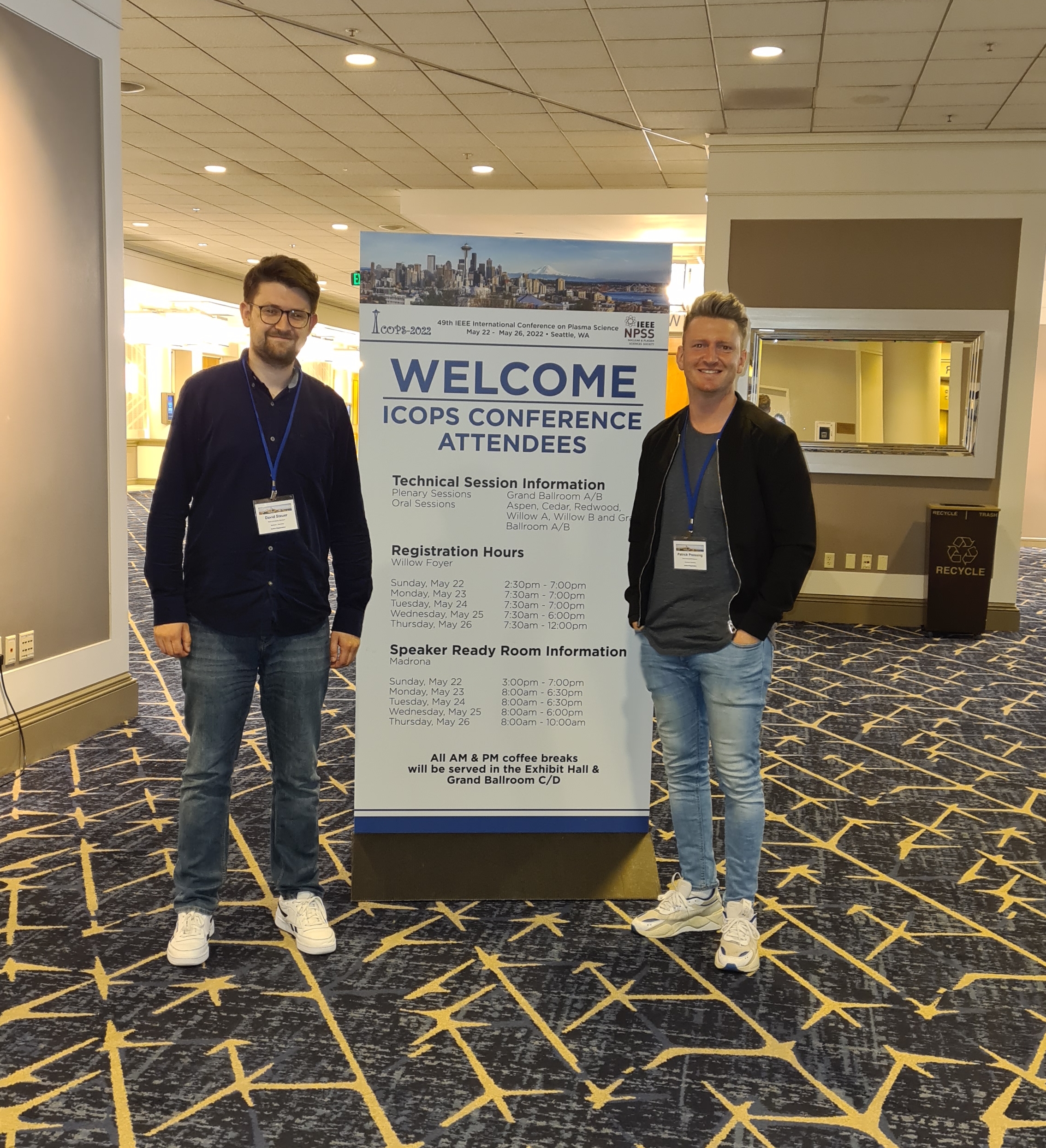
Die 49. Internationale Konferenz für Plasmawissenschaften (ICOPS) fand vom 22. bis 26. Mai in Seattle statt. Es war eine der ersten Konferenzen seit Beginn der COVID-Pandemie, die als Hybrid-Konferenz organisiert war und teilweise vor Ort stattfand. Es war schön, wieder auf einer Live-Konferenz zu sein und mit anderen Forschern persönlich in Kontakt zu kommen. Mehr als 350 Teilnehmer besuchten die Konferenz vor Ort und mehr als 150 Forscher nahmen virtuell an der Konferenz teil. Tagungsort war das Sheraton Grand Seattle im Stadtzentrum von Seattle. Das wissenschaftliche Programm umfasste eine breite Palette von Themen aus dem Bereich der Plasmaphysik, von grundlegenden Phänomenen in Hochtemperatur-Fusionsplasmen oder Niedertemperatur-Plasmastrahlen bis hin zu den Anwendungen der verschiedenen Quellen, z. B. in der Medizin, der Landwirtschaft oder für Umweltzwecke.
Neben dem wissenschaftlichen Programm gab es in der Umgebung viel zu entdecken, wie z. B. einen Bummel über den berühmten Pike Place Market oder einen Aufstieg auf die Space Needle, von der aus man einen großartigen Blick über die Stadt und den 4392 m hohen Vulkan Mount Rainier hat, sofern er sich nicht in dichten Wolken versteckt. Während der Konferenz fand eine spontane Gruppenveranstaltung statt, bei der wir zusammen mit etwa 30 anderen Forschern das Nachtleben von Seattle erkundeten, und die Konferenz wurde schließlich mit einem schönen Bankett abgeschlossen.
Patrick Preissing, Projekt B2
Interantionalization
ICOPS conference in Seattle
The 49th International Conference on Plasma Science (ICOPS) was held in Seattle from May 22 through May 26. It was one of the first conferences since the beginning of the COVID pandemic situation that was organized as a hybrid conference and partly held on site. It was nice to be back at a live conference getting in touch face to face with other researchers. More than 350 on site attendees visited the conference and more than 150 researchers joined the conference virtually. The conference venue was the Sheraton Grand Seattle located in Seattle Downtown. The scientific program reached out to wide varieties in the field of plasma physics covering topics such as basic phenomena in high temperature fusion plasmas or low temperature plasma jets up to the applications of different sources as for example in medicine, agriculture or for environmental purposes.
Beside the scientific program there were lots of things to discover around the area such as strolling at the famous Pike Place Market or going up the Space Needle to get a great view over the city and the 4392m high volcano Mount Rainier, if it does not hide itself in dense clouds. During the conference a spontaneous group event took place, exploring the night life of Seattle together with around 30 other researchers and the conference was eventually closed with a nice banquet.
Patrick Preissing, project B2
Career Orientation
Girls'Day 2022
On April 28th, the annual Girls'Day took place. Offering a 5-hour hands-on workshop on plasma physics, female students could dive into university physics as well as learn more about science, studying and career options pursuing studies in physics. During the workshop, the school students first got to know the basics of plasma – what does it consist of, how can we influence its behaviour and which characteristics does it have. Following this rather theoretical part, the school students worked on the sputter coater, making samples to analyse with a profilometer and identify the thickness of the surface coating from the sputtering process. The aim of the Girls’ Day is to offer female school students an insight into technical and scientific careers and motivate more school students to choose a degree in a MINT-subject. We also aim at reducing prejudices and fears towards a physics degree.
Outreach
Students' Project Week Easter 2022
During the first week of the Easter break, the project weeks for female high school students (in German Schülerinnenprojektwoche) took place and opened the doors towards plasma physics, astronomy and physics in medicine for school students grade 8 to 10. Hosting three projects, the offer is continuously expanding after the Corona lockdown. During the project week, students attended a lecture given by PD Dr. Horst Fichtner on ‘news from the edge of the solar system’, visited the Planetarium in Bochum and worked on scientific projects during their workshops. The outcomes of the research projects were presented in a poster session followed by a quiz and shared lunch, which formed the conclusion of the week. To lower the entry barrier of the project week and offer school students the chance to participate no matter of their financial status, some changes were implemented as a trial. School students who do not own a ticket for public transport had the option to receive a ticket for transportation to and from university. Also, meals were newly included in the project week. While only breakfast used to be supplied, students could now share a free lunch in the campus dining hall, enhancing the group dynamics and their feeling of belonging in the group. The feedback to this changes were positive according to the feedback of the participants, so that the changes will be continuously adapted to the program of the project week The project week in autumn will presumably take place with four projects at full capacity.