


Materialdownload*
Der Plasma-Truck wird mit einem sogenannten Forschungsbuch begleitet, dass sich der teilnehmende Kurs laden kann und so die Experimente begleitet werden. Es ist ausgelegt, dass die SuS dieses auf dem ipad laden und die einzelnen Stationen bearbeiten. Zu jeder Station gibt es eine Einleitung mit Anknüpfungen an den Unterricht. Darauf aufbauend sind dann die Experimente an den Plasmaröhren gedacht. Das Materialheft für die SuS für den Plasmatruck kann hier* geladen werden.
Ein Video* gibt vor der Unterrichtseinheit eine Einführung in Plasmen allgemein:
Weiteres Material (Videos der einzelnen Plasmaröhren) kann gebündelt hier* geladen werden.
*Das Material ist passwortgeschützt und kann man auf Nachfrage bekommen per E-Mail-Anfrage an sfb1316(at)rub.de
Plasma Truck
The Plasma Truck is on the road again!
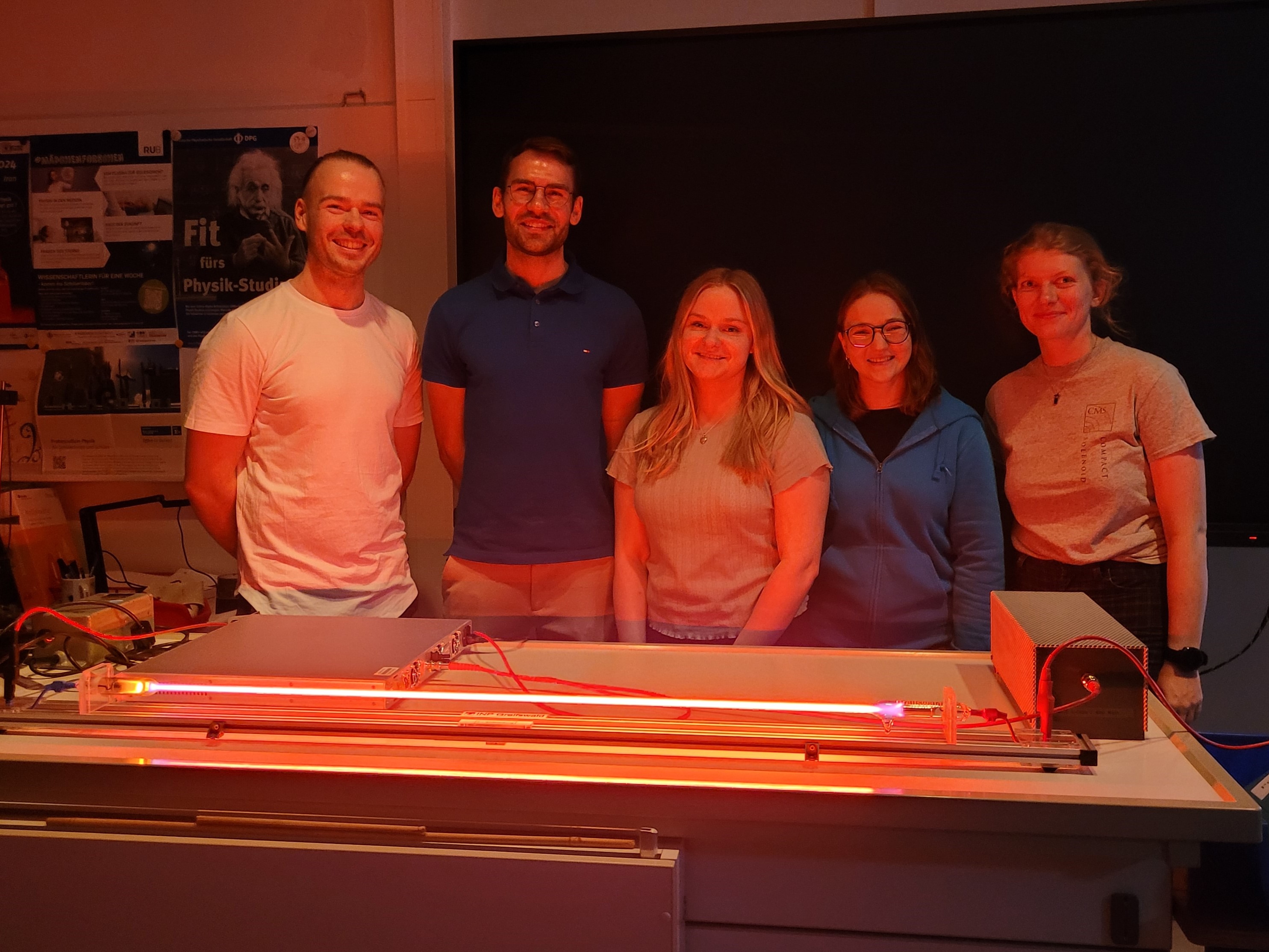 On 20th June, physics students and PhD students in physics and electrical engineering from Ruhr-University Bochum visited the Burggymnasium Essen. The high school students from grades 11 and 12 participate in the mobile workshop. They conducted exciting plasma experiments, used a spectrometer to analyse the light emission and observed how plasmas can be influenced by electrical and magnetic fields. The workshop was a success and the students showed great interest.
Although plasma physics is not part of the curriculum, some experiments in school lessons involve plasmas. The mobile workshop was developed to familiarise high school students with the concept of plasma. Experiments were designed that can be transported to school in a minibus. During the 90-minute workshop, the students experiment in small groups and learn about plasmas and their various applications.
Public research activities
"Mobile plasma workshop" for high school students finished
The last working step for the recent project of public relations is completed. The plasma truck, namely the mobile workshop for students, addresses physics courses within the last two years of school time.
The didactic concept of the workshop is the deepening of existing knowledge by connecting the pre-known physics with concepts from plasma physics. The concept was developed together with the research group physics didactics of Prof. Krabbe at the faculty of physics and astronomy at Ruhr-University Bochum. Within the framework of a Master thesis, Jasmin Schmidt analysed the existing knowledge of the students concerning plasmas. She found that a lot of experiments and descriptions of phenomena were treated during the classes, but have not been connected to plasmas.
Here, the workshop picks up the known experiments and categorises them in a new way. Finally, interested school classes in and around Bochum can book the workshop for a time period of 90 minutes. On the day of the workshop, public relations staff as well as assistant students will visit the school class. A short movie has been produced to introduce the audience to the topic. Finally, the students have the chance to work on the experiments by themselves in small groups. A booklet with information on the experiments leads through the workshop. First groups might try out the workshop after the summer holidays in case that Covid-19 measures are allowing it.
Maike Kai & Marina Prenzel, public relations CRCs