


- Details
Japanese core-to-core program
Two PhD students profit from research stay at Hamaguchi Lab, Center for Atomic and Molecular Technologies, Osaka University, Osaka
From October to December 2019, I was able to join the lab of Prof. Satoshi Hamaguchi at the Center for Atomic and Molecular Technologies in Osaka, Japan.
My field of research is applied microbiology and my focus is on biocatalytic reactions with non-thermal plasmas.
Using numerical simulations, I studied the propagation of plasma-induced reactive species in liquids to gain an insight on the depth of penetration and concentration of these species. This knowledge will help to understand the interaction between plasmas and enzymes that are studied in project B8 of the CRC 1316, specifically to protect the enzymes from inactivation and to drive biocatalysis.
The research stay in Japan was very helpful to deepen my knowledge for my main research question.
Abdulkadir Yayci, project B8 of the CRC 1316
I have visited Hamaguchi Laboratories at Osaka University in Japan for 3 months. The lab exchange was funded partially by the CRC-1316 and the JSPS core-to-core program. The group of Prof. Satoshi Hamaguchi developed a reaction-diffusion-convection simulation for the generation and transport of chemical species in water, introduced by atmospheric-pressure plasma. During my stay, I worked on a multiphase fluid model. The typical flow field of a turbulent atmospheric-pressure plasma jet in direct vicinity of a liquid was modelled by solving a k-epsilon turbulence model. A Volume-of-Fluid (VOF) method was applied for the coupled flow of gaseous and liquid phase. The simulations agree very well with experimental results in the literature. The results from the fluid flow simulations were integrated into the reaction-diffusion-convection equations to evaluate the influence of different flow regimes on the generation and transport of chemical species in the liquid.
At Bochum University, I am working as a PhD student within project B5 of the CRC 1316: 2D-plasma-liquid-solid interfaces – plasma electrolytic oxidation. The generated results can be useful for this project in regards of chemical species generation inside of liquids. In addition, the fluid flow model is interesting for other groups working with atmospheric-pressure plasmas (e.g. project B2: Self-organization of sub-µm surface structures stimulated by microplasma generated reactive species and short-pulsed laser irradiation).
Summarizing I can say, that I had a very pleasant stay in Osaka, that I personally enjoyed a lot. The cooperation with the Hamaguchi Laboratories were very fruitful and everyone was very kind during my stay.
Patrick Hermanns, project B5 of the CRC 1316
- Details
Eickhoff prize
Dr.-Ing. Schmidt is awarded for his outstanding dissertation
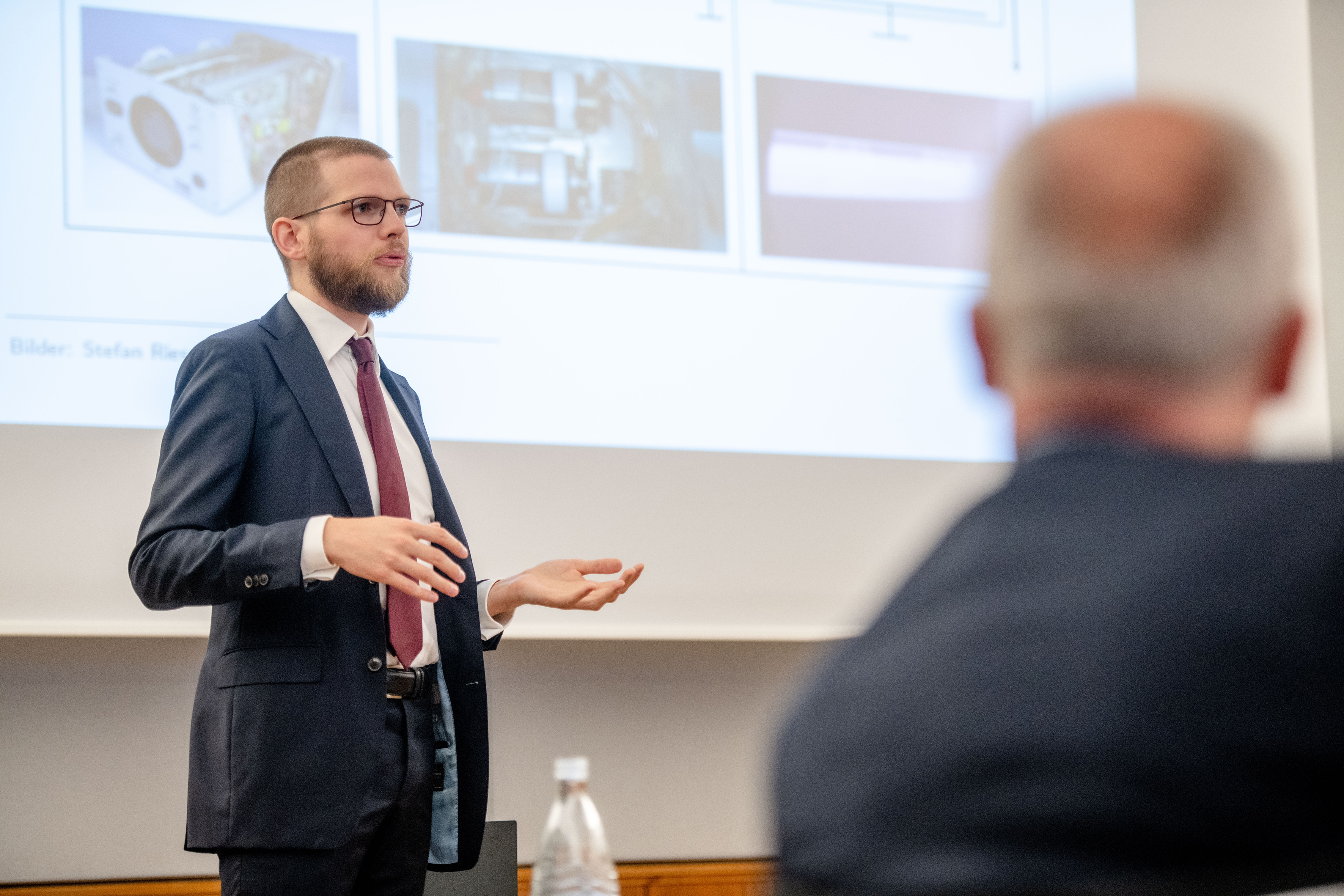
Technical plasmas are among the things that have a significant influence on the world around us, without many people knowing about it. "You can, for example, process surfaces with plasmas; but they are crucial in the production of modern computer chips, which are built into almost all modern technical devices - from cars to smart phones," explains Frederik Schmidt. "A better understanding of this technology leads to innovations that make our lives easier, network people and shape our future.
In his dissertation, he investigated how the energy gets into a plasma. The path from the power socket to nanometer-sized semiconductor tracks is being investigated by various specialists and is in part well understood. Frederik Schmidt has brought together two of these specialist areas: the electrical network between the power socket and the plasma on the one hand, and detailed plasma simulations on the other. This makes it possible to investigate the relationship between the two. "For example, I have looked at the paths along which energy flows and how much is lost on its way into the plasma. That is sometimes quite a lot," says the researcher. The results help to make systems and superstructures more efficient and thus more economical and ecological. In addition, he has developed his own electrical network that can be implemented for certain applications with considerably less effort and losses than before. "I was able to show theoretically that this works. Colleagues in France were then able to prove in experiments that it is also practically possible to build something like this," says Schmidt.
adapted from Meike Drießen, RUB
- Details
JSPS Core-to-core program
Abdulkadir Yayci visits Japanese colleagues
From October to December 2019, I was able to join the lab of Prof. Satoshi Hamaguchi at the Center for Atomic and Molecular Technologies in Osaka, Japan. My field of research is applied microbiology and my focus is on biocatalytic reactions with non-thermal plasmas. Using numerical simulations, I studied the propagation of plasma-induced reactive species in liquids to gain an insight on the depth of penetration and concentration of these species. This knowledge will help to understand the interaction between plasmas and enzymes that are studied in project B8 of the CRC 1316, specifically to protect the enzymes from inactivation and to drive biocatalysis. The research stay in Japan was very helpful to depen my knowledge for my main research question.
- Details
JSPS Core-to-core program
Patrick Hermanns visit research group in Osaka
I have visited Hamaguchi Laboratories at Osaka University in Japan for 3 months. The lab exchange was funded partially by the CRC-1316 and the JSPS Core-to-core program. The group of Prof. Satoshi Hamaguchi developed a reaction-diffusion-convection simulation for the generation and transport of chemical species in water, introduced by atmospheric-pressure plasma.
During my stay I worked on a multiphase fluid model. The typical flow field of a turbulent atmospheric-pressure plasma jet in direct vicinity of a liquid was modelled by solving a k-epsilon turbulence model. A Volume-of-Fluid (VOF) method was applied for the coupled flow of gaseous and liquid phase. The simulations agree very well with experimental results in the literature. The results from the fluid flow simulations were integrated into the reaction-diffusion-convection equations to evaluate the influence of different flow regimes on the generation and transport of chemical species in the liquid.
In Bochum University, I am working as a PhD-Student within project “B5: 2D-plasma-liquid-solid interfaces – plasma electrolytic oxidation“. The results generated can be useful for this project in regards of chemical species generation inside of liquids. In addition, the fluid flow model is interesting for other groups working with atmospheric-pressure plasmas (e.g. B2: “Self-organization of sub-µm surface structures stimulated by microplasma generated reactive species and short-pulsed laser irradiation“). Summarizing I can say, that I had a very pleasant stay in Osaka, that I personally enjoyed a lot. The cooperation with Hamaguchi Laboratories were very fruitful and everyone was very kind during my stay.
- Details
MGK
International School on Low Temperature Plasma Physics: Basics and Applications 2019
The traditional summer school on low temperature plasma physics was held in the Physikzentrum in Bad Honnef and from Octobre 5th, 2019 until Octobre 12th, 2019. The PIs contributed to the lecturing program and new PhD and master students of the CRC1316 attended the school.