


- Details
Pupil's project week
Eventful project week full of physics and research
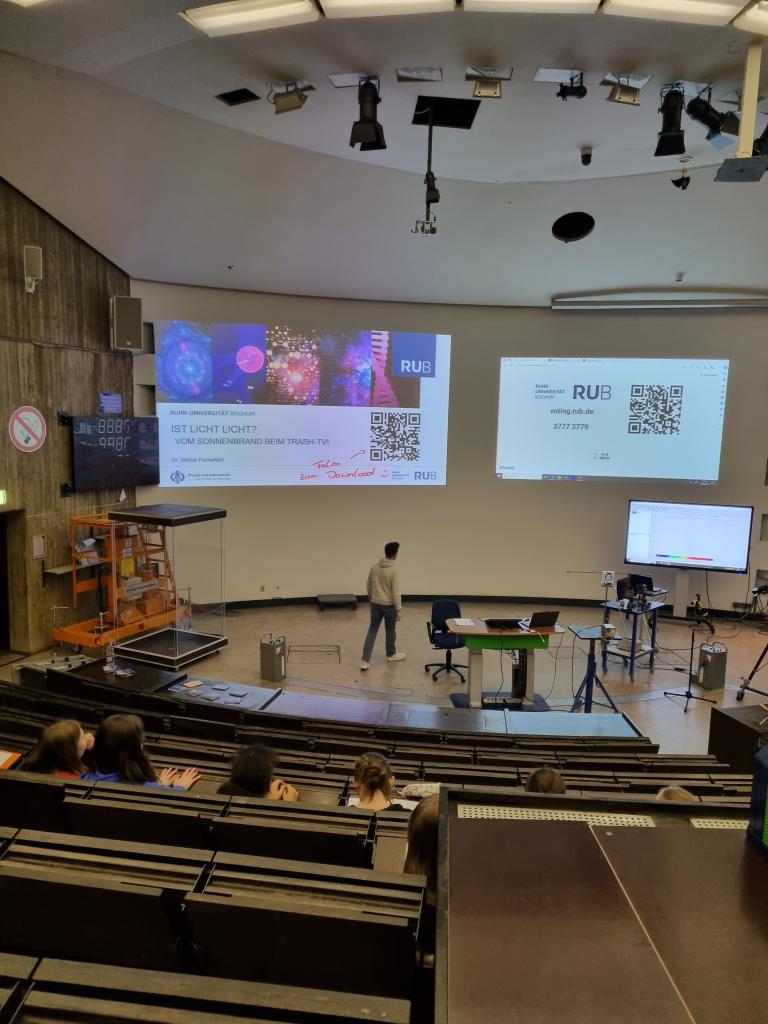
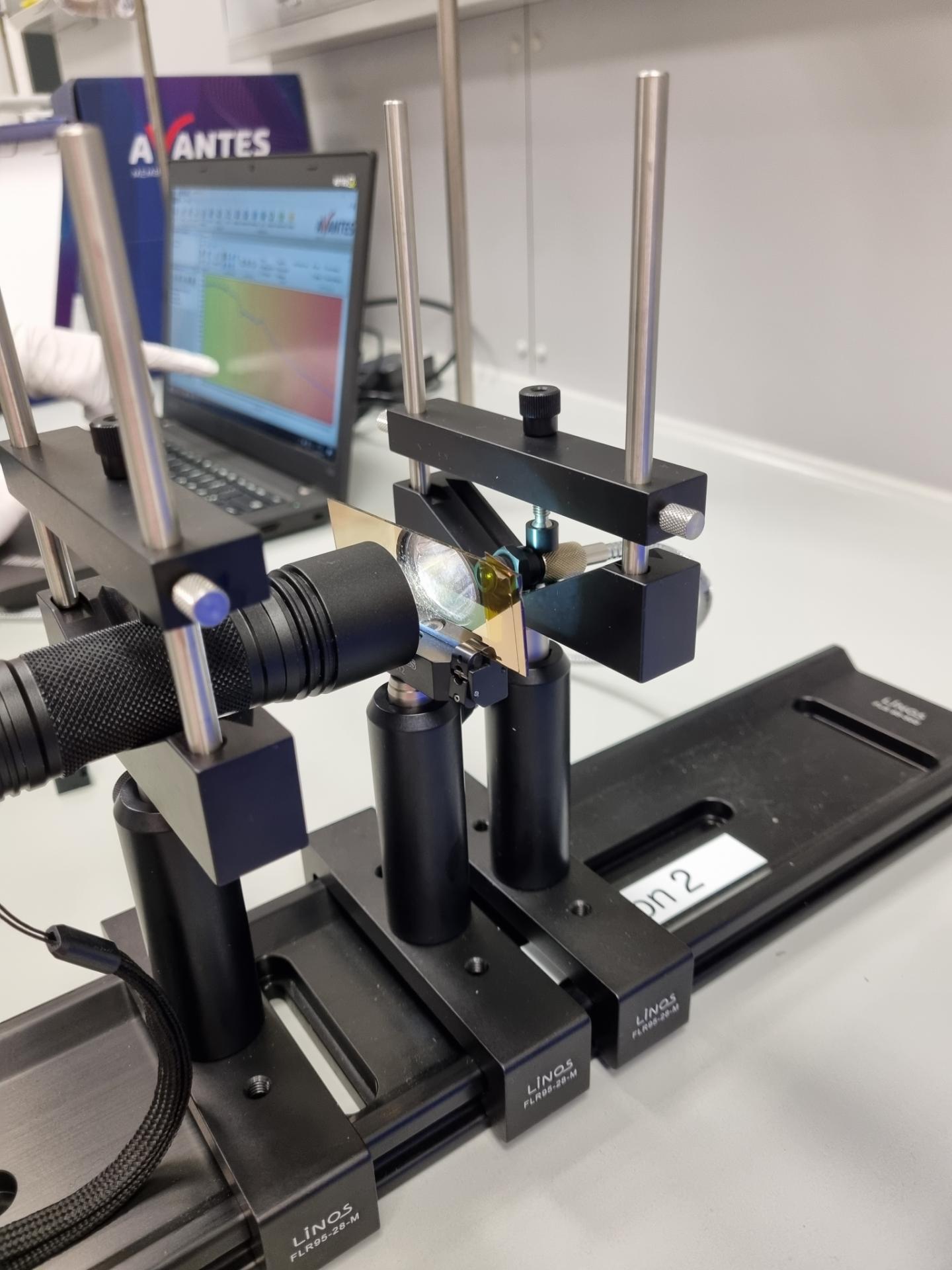
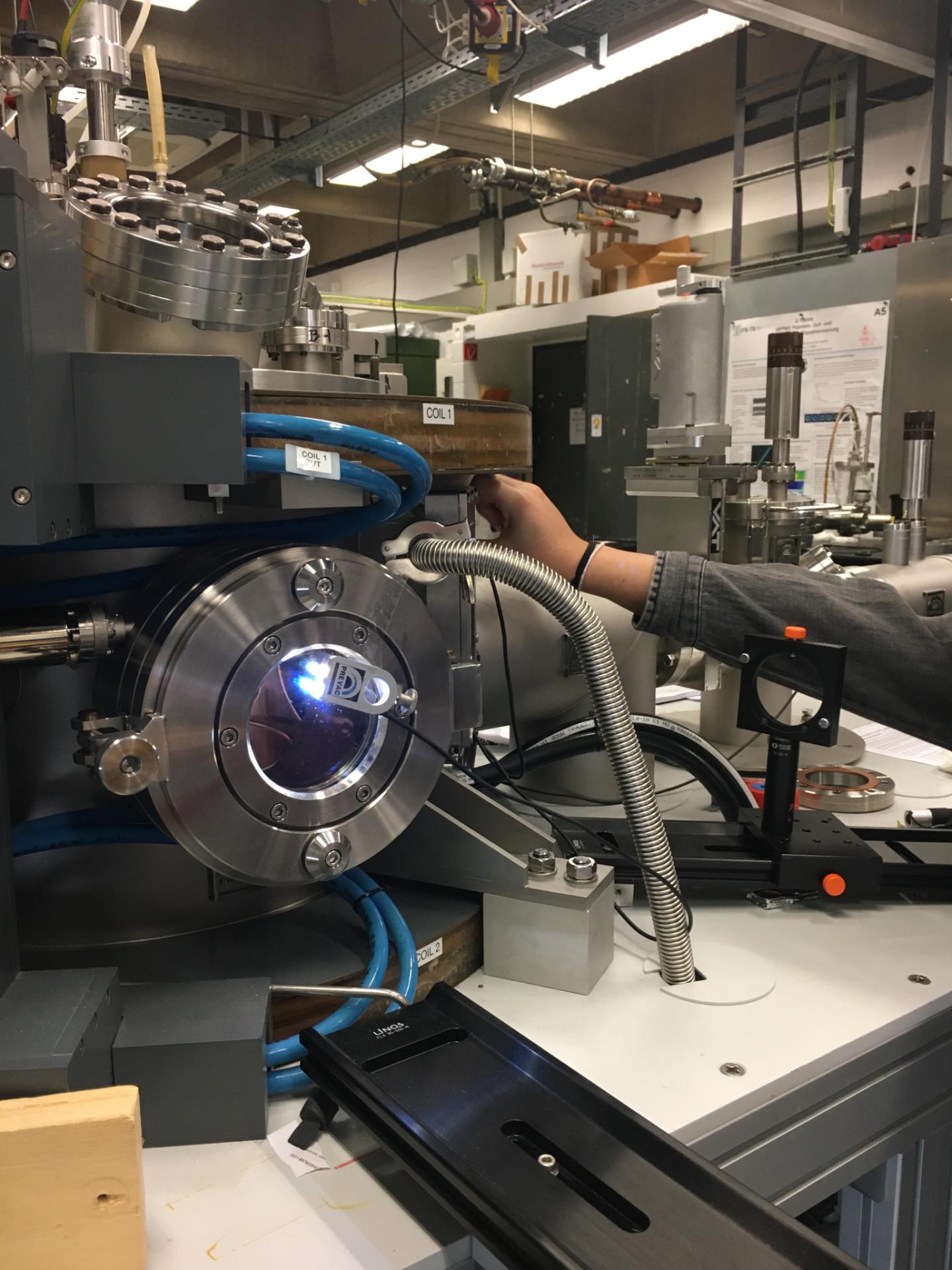
This year's schoolgirl project week took place at the RUB from March 25 to 28.
In addition to exciting workshops and experiments, the schoolgirls attended a lecture by Dr. Niklas Fornefeld on the topic of "Thermal radiation 'Is light light?' - From sunburn to trash TV", experienced current research at the RUB in laboratory tours and traveled through the vastness of space in the Zeiss Planetarium Bochum.
The highlights also included having breakfast together, lunch in the canteen and experiencing university life. This also served as an opportunity for exchange between the participants and the students.
The final event was the fiercely contested physics duel and the award ceremony for the winners. Everyone was then rewarded with a well-earned pizza!
- Details
Plasma physics at Bo.Ing 2024
Pupils learn about the world of plasmas through the Bo.Ing
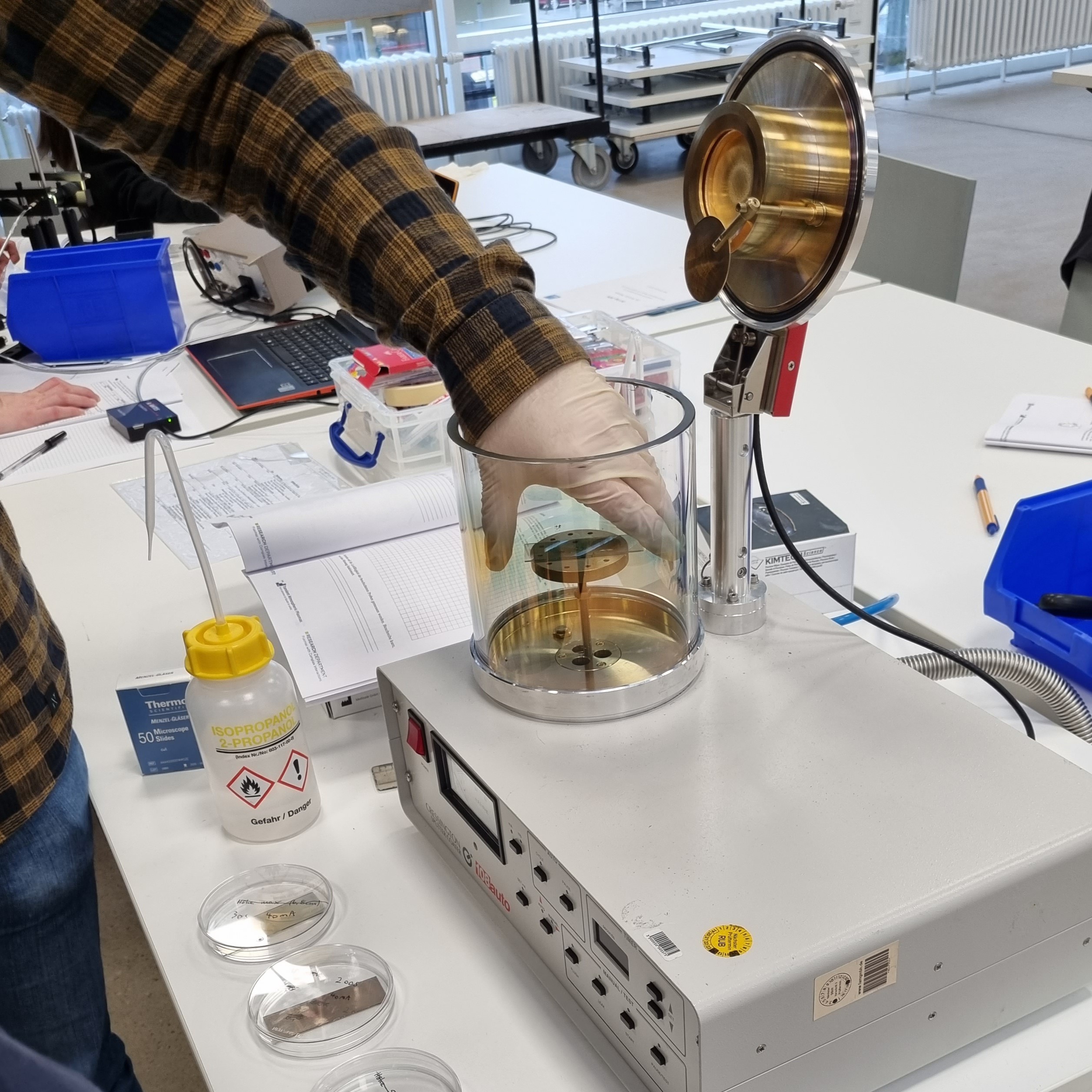 On 20th February the BO.Ing, a study orientation day for engineering studies, took place. High school students attended a lecture, were guided through laboratories, and could participate in exciting workshops such as plasma physics. The high school students learned a lot about plasmas and their applications. They coated samples using the sputter coater and analysed the properties of the produced gold layers.
- Details
Public Relations
Plasma physics events for high school students
The project week for high school students at Ruhr University Bochum is an educational program of the CRC 1316, the Faculty of Physics and Astronomy at the RUB, and of di. The student project week takes place twice a year during the Easter vacations and during the autumn vacations.
From April 3rd to 6th, the project week was hosted for over 60 female students in grades 8 to 10. The girls chose between four workshops: plasma physics, astronomy, physics in medicine, and House of the Future. The project "From Plasma to Gold Layers" allows the students to gain an insight into the generation and applications of plasmas. Using the sputter coater and professional laboratory equipment, the students could deposit and examine gold layers themselves. During the project week, the students attended a lecture by Prof. Dr. Judith Golda on "hands-on plasmas – between material science and medicine "and visited laboratories and the Planetarium Bochum. On the closing day, the results of the students' research were presented in a poster session, followed by a quiz and lunch. The next project week Autumn for female and male students in grades 8 and 9 will occur from the 9th to the 13th of October.
The Faculty of Physics enables students to complete a school internship in Physics.
From March 27th to 31st, we welcomed two interns from grade 9. After a short introduction to plasma physics, the students worked on the sputter coater. They examined the coated samples. For this purpose, they determined the transmission with a spectrometer, the layer thickness with the profilometer, and the conductivity. The interns also gained experience in handling data and in data evaluation. The goal of the internship is also to give an impression of laboratory work and current research. Therefore, doctoral students, bachelor's, and master's students guided the interns through the labs and presented their experiments. The interns also visited the NRW state competition "Jugend forscht," which took place at the Ruhr University Bochum from 27th to 29th March.
The "mobile plasma workshop" took place for the first time on June 5th. Our plasma truck visited an 11th-grade physics class at school. In the beginning, the students watched a short movie and received basic knowledge about plasmas and their applications. After a quick quiz, they worked on the experiments in smaller groups. The students examined the light emitted by plasmas with an optical spectrometer and observed how electric and magnetic fields can influence plasmas. Information on the experiments on the students' iPads guided the workshop. The workshop was a success, and the students showed great interest. As an advanced course in physics, they already had a good understanding of electric and magnetic fields. However, plasma physics is not part of the school curriculum. Through the students' feedback, we have gained insights on how to improve our workshop going forward.
- Details
Outreach
Kick-off event of the Science Year 2023
On Saturday, 11.02.2023, the kick-off event of the Science Year 2023 "Our Universe" took place. The SFB 1316 was represented with a booth at the Zeiss Planetarium Bochum.
Besides live experiments, there was a varied program with a plasma quiz, coloring pictures and slide show. As live experiments, the plasma sphere and plasma mass were presented as hands-on experiments, and the plasma speaker and COST jet were shown for demonstration. Here, the new portable COST-Jet could be used for the first time outside the university. Thanks to its construction on a plate with gas supply, generator and holders for optical fibre and spectrometer, another experiment and authentic diagnostics from the laboratory can now be shown at events.
A big thank you to the many helping hands and all interested people who visited us!
- Further information on the Science Year can be found here.
- Details
Outreach
Plasmas for renewable energies
 Achim von Keudell gave a lecture on "Plamas for renewable energies" in the popular lecture series "Saturday morning physics" of the faculty for physics and astronomy on the 10th December 2022. He highlighted the various research topics of the CRC 1316.
- Details
Outreach
New concept introduced in the plasma workshop of the project week
The project week for students at Ruhr University Bochum in grade 8 and 9 is a educational offer of the CRC 1316, Faculty of Physics and Astronomy from RUB and is greatly supported by zdi . From 4th to 7th October, the project week took place with four workshops hosting over 60 high school students.
The concept of the plasma workshop “From plasma to gold coating” was adapted accordingly to feedback by students and workshop leaders from the last years. The focus of the topics was shifted from theoretical work towards application based discussions with exercises to practice and apply newly gained knowledge. The focus has been set to enable the students to plan and execute their research as well as analyse the data and present their findings creatively and self-determined. The workshop leaders and material should guide through the workshop, offering the students a democratic say in the concrete design of the week.
To adapt the material to modern standards and the vast digital resources available for student online, the project guide now includes online resources that can be used for better understanding or diving deeper into different topics by using the QR-codes to access articles and videos. In the future, this guide can also be used with and on tablets and as a digital version, enhancing the interactivity and individualisation of the learning process of the students even further.
- You can find further information on the project week on the website of the Faculty for Physics and Astronomy.
- Details
Experience Physics
Announcement of Students' Project Week Autumn 2022
From October 4th to 7th 2022, the students' project week for for all students attending grade 8 and 9 will once again take place in the Alfried Krupp student laboratory of the Ruhr University Bochum. Registration will be open as early as 15.08.22 online.
- Information on the projects and the schedules event can be found on the official website of the students' project week.
- Details
Career Orientation
School internship in plasma physics
Laboratory - you often see little of it at school. However, one opportunity is during an internship in physics. While in recent years we have often carried out project work on the sputter coater during the week, the programme is now being expanded. This is intended to give students a deeper insight into the laboratories and current research. In addition, they can generate their own authentic data through their own small work on experiments that are otherwise used by bachelor's and master's students. In view of the ever-growing importance of digital data evaluation and safe handling of data on the computer, this area is now also more strongly included in the programme. Thus, interns can gain experience with Excel, Python or other data analysis programmes according to their individual prior knowledge. The data is obtained by means of diagnostics that are also frequently used in everyday laboratory work. Optical emission spectroscopy offers a wide range of applications that generate exciting data, which is also tangible and evaluable for students through its graphical representation.
From 20th to 24th June, we welcomed Lilly to the department. After a short theoretical introduction to the basics of plasma physics, we immediately continued with the work on the sputter coater. In addition, several doctoral students and students presented their experiments and laboratories in laboratory tours or offered to work together in the laboratory. For half a day, she worked independently on the COST-Jet and carried out OES measurements for voltage and oxygen admixture variations. After evaluating the data, she and David, who also supervises the experiment for students, discussed and analysed the data together.
In addition to the laboratory work, many interns also ask themselves "Is studying physics the right thing for me?". So, we always try to offer an insight into undergraduate lectures and seminars.
- Are you also interested in an internship in physics? You can find more information about school internships at the faculty here.
- Details
Career Orientation
Girls'Day 2022
On April 28th, the annual Girls'Day took place. Offering a 5-hour hands-on workshop on plasma physics, female students could dive into university physics as well as learn more about science, studying and career options pursuing studies in physics. During the workshop, the school students first got to know the basics of plasma – what does it consist of, how can we influence its behaviour and which characteristics does it have. Following this rather theoretical part, the school students worked on the sputter coater, making samples to analyse with a profilometer and identify the thickness of the surface coating from the sputtering process. The aim of the Girls’ Day is to offer female school students an insight into technical and scientific careers and motivate more school students to choose a degree in a MINT-subject. We also aim at reducing prejudices and fears towards a physics degree.