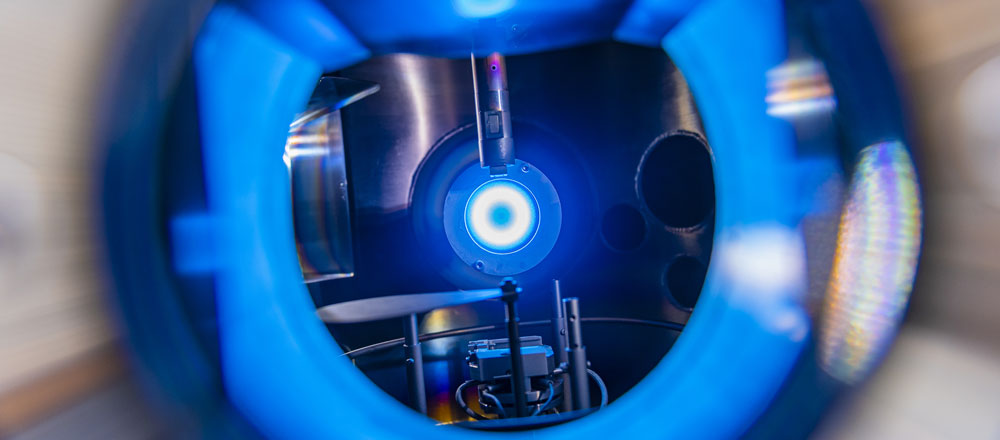

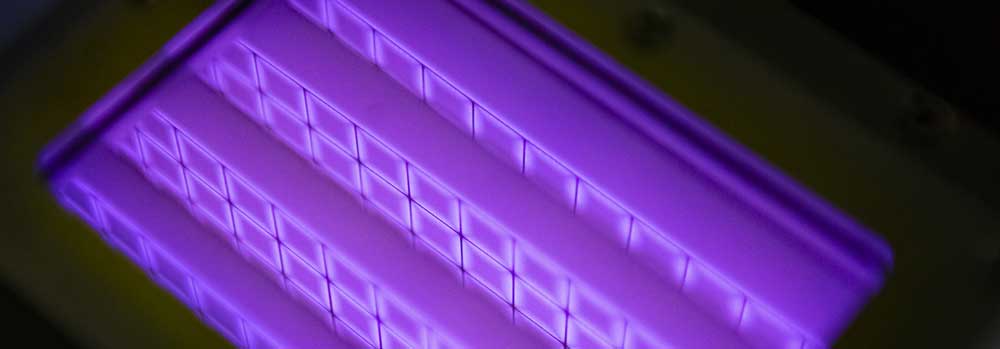
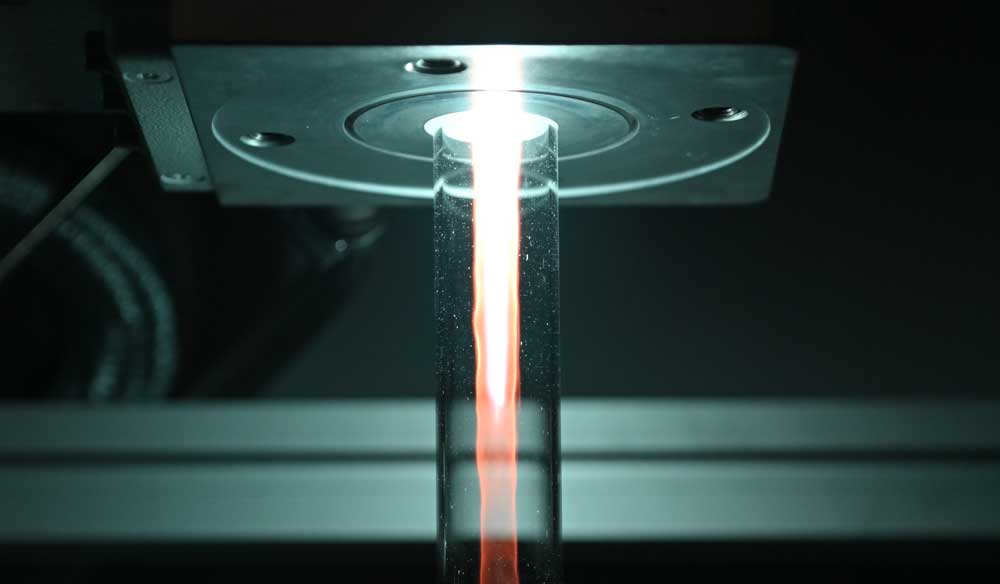






A3,A7 - Plasma ChemistryGas Conversion in an sDBDSurface Dielectric barrier discharges are perfect |
RECENT RESEARCH ACHIEVEMENT, project B8
How bacteria protect themselves from plasma treatment

Plasmas are applied in the treatment of wounds to combat pathogens that are resistant against antibiotics. But bacteria know how to defend themselves.
Considering the ever-growing percentage of bacteria that are resistant to antibiotics, interest in medical use of plasma is increasing. In collaboration with colleagues from Kiel, researchers at Ruhr-Universität Bochum (RUB) investigated if bacteria may become impervious to plasmas, too. They identified 87 genes of the bacterium Escherichia coli, which potentially protect against effective components of plasma. “These genes provide insights into the antibacterial mechanisms of plasmas,” says Marco Krewing. He is the lead author of two articles that were published in the Journal of the Royal Society Interface this year.
A cocktail of harmful components stresses pathogens
Plasmas are created from gas that is pumped with energy. Today, plasmas are already used against multi-resistant pathogens in clinical applications, for example to treat chronic wounds. “Plasmas provide a complex cocktail of components, many of which act as disinfectants in their own right,” explains Professor Julia Bandow, Head of the RUB research group Applied Microbiology. UV radiation, electric fields, atomic oxygen, superoxide, nitric oxides, ozone, and excited oxygen or nitrogen affect the pathogens simultaneously, generating considerable stress. Typically, the pathogens survive merely several seconds or minutes.
In order to find out if bacteria, may develop resistance against the effects of plasmas, like they do against antibiotics, the researchers analysed the entire genome of the model bacterium Escherichia coli, short E. coli, to identify existing protective mechanisms. “Resistance means that a genetic change causes organisms to be better adapted to certain environmental conditions. Such a trait can be passed on from one generation to the next,” explains Julia Bandow.
Mutants missing single genes
For their study, the researchers made use of so-called knockout strains of E. coli. These are bacteria that are missing one specific gene in their genome, which contains approximately 4,000 genes. The researchers exposed each mutant to the plasma and monitored if the cells kept proliferating following the exposure.
“We demonstrated that 87 of the knockout strains were more sensitive to plasma treatment than the wild type that has a complete genome,” says Marco Krewing. Subsequently, the researchers analysed the genes missing in these 87 strains and determined that most of those genes protected bacteria against the effects of hydrogen peroxide, superoxide, and/or nitric oxide. “This means that these plasma components are particularly effective against bacteria,” elaborates Julia Bandow. However, it also means that genetic changes that result in an increase in the number or activity of the respective gene products are more capable of protecting bacteria from the effects of plasma treatment.
Heat shock protein boosts plasma resistance
The research team, in collaboration with a group headed by Professor Ursula Jakob from the University of Michigan in Ann Arbor (USA), demonstrated that this is indeed the case: the heat shock protein Hsp33, encoded by the hslO gene, protects E. coli proteins from aggregation when exposed to oxidative stress. “During plasma treatment, this protein is activated and protects the other E. coliproteins – and consequently the bacterial cell,” Bandow points out. An increased volume of this protein alone results in a slightly increased plasma resistance. Considerably stronger plasma resistance can be expected when the levels of several protective proteins are increased simultaneously.
By Meike Drießen, Translated by Donata Zuber
Awards
Poster Prize for Christoph Stewig (A3) at the Conference for Plasma Technology 19 in Cottbus
Christoph Stewig was awarded with one of the three poster prizes at the bi-annual conference on plasma technology in Cottbus.
Project B7 - Nanosecond plasmas
Extreme Conditions in Plasma in Liquids
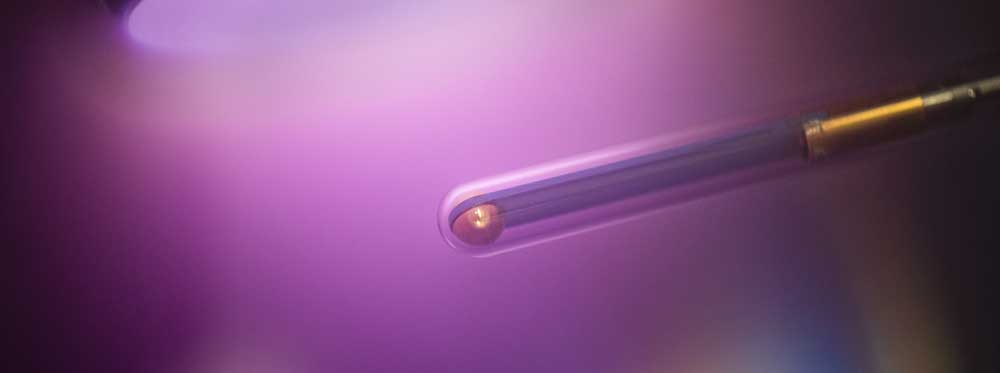
Nanosecond plasmas in liquids play an important role in the field of decontamination, electrolysis or plasma medicine. The understanding of these very dynamic plasmas requires information about the temporal variation of species densities and temperatures. This is analyzed by monitoring nanosecond plasmas that are generated by high voltages (HV) between 14 kV and 26 kV and pulse lengths of 10 ns applied to a tungsten tip with 50 µm diameter immersed in water. Ignition of the plasma causes the formation of a cavitation bubble that is monitored by shadowgraphy to measure the dynamic of the created bubble and the sound speed of the emitted acoustic waves surrounding this tungsten tip.
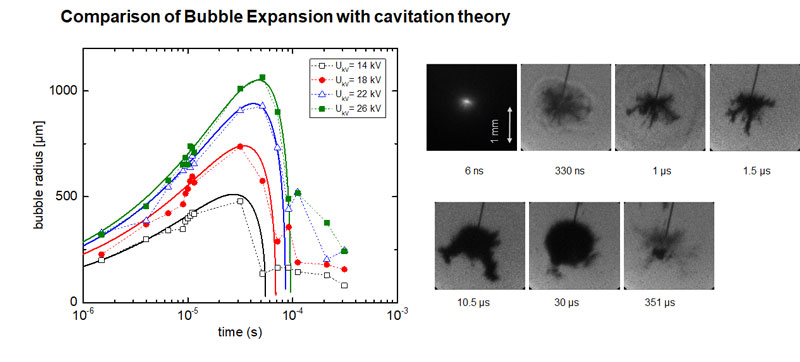
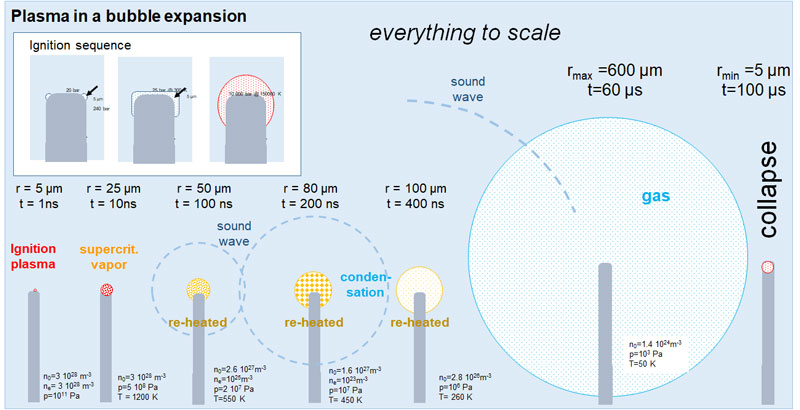
The temporal evolution of the bubble size is compared with cavitation theory yielding good agreement for an initial bubble radius of 25 µm with an initial pressure of GPa at a temperature of 1200 K for a high voltage of 18 kV. This yields an initial energy in the range of a few 10-5 J that varies with the applied high voltage. The dissipated energy by the plasma drives the adiabatic expansion of water vapor inside the bubble from its initial supercritical state to a low pressure, low temperature state at maximum bubble expansion reaching values of 10^3 Pa and 50 K, respectively. These predictions from cavitation theory are corroborated by optical emission spectroscopy (OES). After igniting the nanosecond plasma, the electrical power oscillates in the feed line between HV pulser and plasma chamber with a ring down time of the order of 60 ns. These reflected pulses re-ignite a plasma inside the expanding bubble periodically. Broadband emission due to recombination and Bremsstrahlung becomes visible within the first 100 ns. At later times, line emission dominates. Stark broadening of the spectral lines of H_alpha (656 nm) and OI (777 nm) is evaluated to determine both the electron density and the electron temperature in these re-ignited plasmas.
MGK
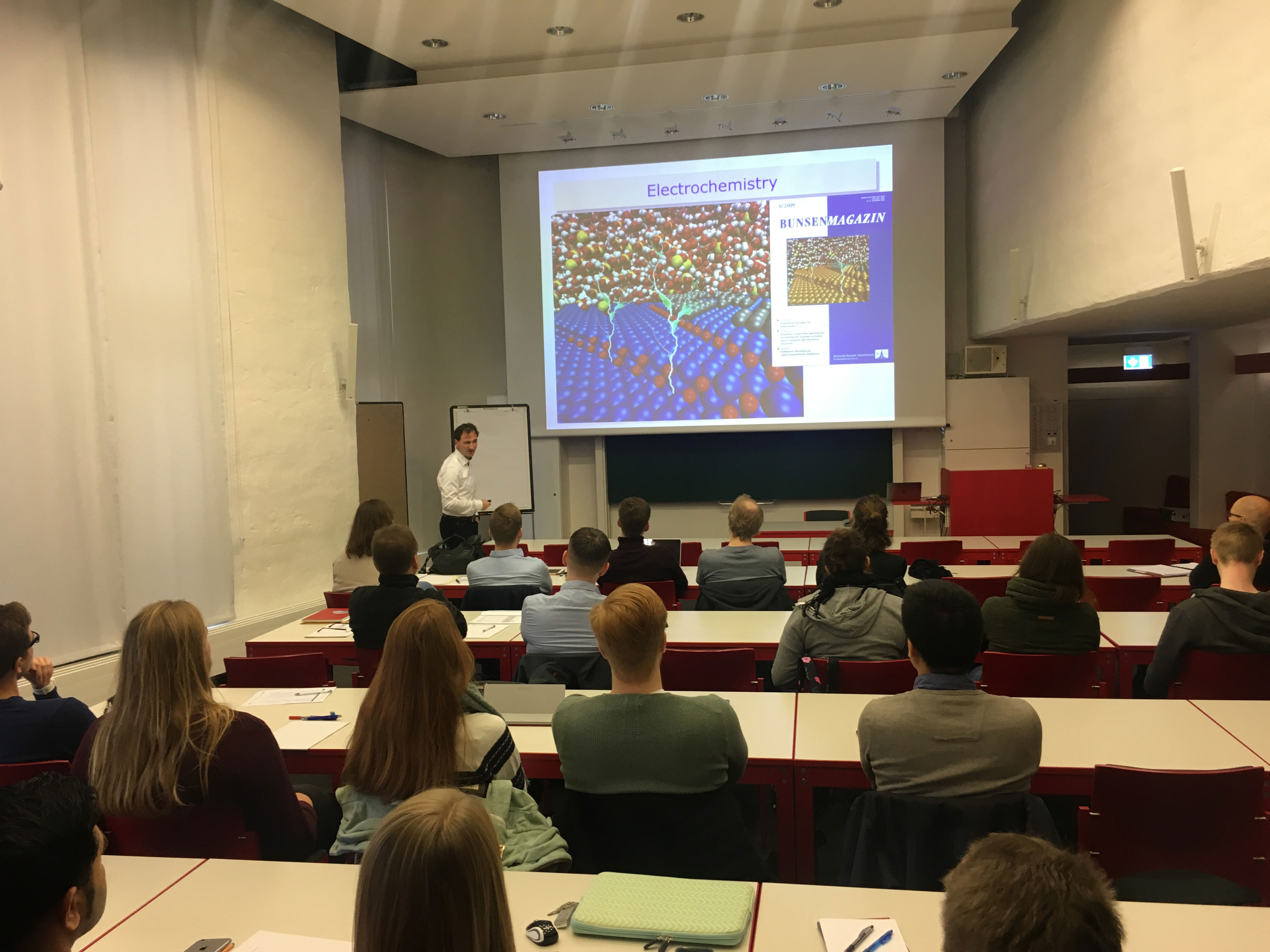
Workshop Electrochemistry
The team of the PI Timo Jacob at University Ulm organized a workshop on the basics and applications of electrochemistry. The similarity to plasma science is striking, with the Debye-Hückel theory being at the core of both systems - plasmas and electrochemistry in the electrolyte. Nevertheless, significant differences exist because the boundary layer in the electrolyte in front of an electrode is much more complex than in a plasma sheath region. The workshop topics ranged from a general introduction to electrochemistry to methods to electro catalysis up to the theoretical modeling of electrochemical processes.