



B5 - Plasma in liquidsBubble dynamicsGas bubble dynamics during Plasma Electrolytic Oxidation |
Career Orientation
School internship in plasma physics
Laboratory - you often see little of it at school. However, one opportunity is during an internship in physics. While in recent years we have often carried out project work on the sputter coater during the week, the programme is now being expanded. This is intended to give students a deeper insight into the laboratories and current research. In addition, they can generate their own authentic data through their own small work on experiments that are otherwise used by bachelor's and master's students. In view of the ever-growing importance of digital data evaluation and safe handling of data on the computer, this area is now also more strongly included in the programme. Thus, interns can gain experience with Excel, Python or other data analysis programmes according to their individual prior knowledge. The data is obtained by means of diagnostics that are also frequently used in everyday laboratory work. Optical emission spectroscopy offers a wide range of applications that generate exciting data, which is also tangible and evaluable for students through its graphical representation.
From 20th to 24th June, we welcomed Lilly to the department. After a short theoretical introduction to the basics of plasma physics, we immediately continued with the work on the sputter coater. In addition, several doctoral students and students presented their experiments and laboratories in laboratory tours or offered to work together in the laboratory. For half a day, she worked independently on the COST-Jet and carried out OES measurements for voltage and oxygen admixture variations. After evaluating the data, she and David, who also supervises the experiment for students, discussed and analysed the data together.
In addition to the laboratory work, many interns also ask themselves "Is studying physics the right thing for me?". So, we always try to offer an insight into undergraduate lectures and seminars.
- Are you also interested in an internship in physics? You can find more information about school internships at the faculty here.
Internationalization
CRC 1316 at the International Conference on Plasma Medicine
In the summer, Dr. Sebastian Burhenn and Steffen Schüttler, together with Sabrina Klopsch and Tim Dirks from the RUB Applied Microbiology group, visited the 9th International Conference on Plasma Medicine (ICPM9) in Utrecht, the Netherlands. Around 250 participants discussed the current state of plasmas in medicine. Topics ranged from "Plasma Agricultural Applications" to "Plasma-Liquid Interactions" to "Plasma-Based Decontamination and sterilisation" and much more.
Sebastian Burhenn gave a presentation in the section "Fundamentals of Atmospheric Plasma" on the "Influence of Humidity on OH Distribution in the COST Jet measured by Laser-Induced Fluorescence". Steffen Schüttler contributed to the section "Plasma-Liquid Interactions" with his talk on "Hydrogen peroxide production in water treated with a capillary plasma jet". Sabrina Klopsch and Tim Dirks presented a poster about their work in the field of plasma-driven biocatalysis.
Internationalization
CRC 1316 members on the ICPM9
Four research members of the CRC 1316 join the 9th International Conference on Plasma Medicine (ICPM9). Today, Sebastian Burhenn talked about the 'Impact of humidity on the OH distribution in the effluent of the COST-Jet measures by laser induced fluorescence'. Another highlight is the plenary talk of the CRC PI Julia Bandow on 'Plasma-driven biocatalysis: challenges and opportunities'.
Interantionalization
ICOPS conference in Seattle
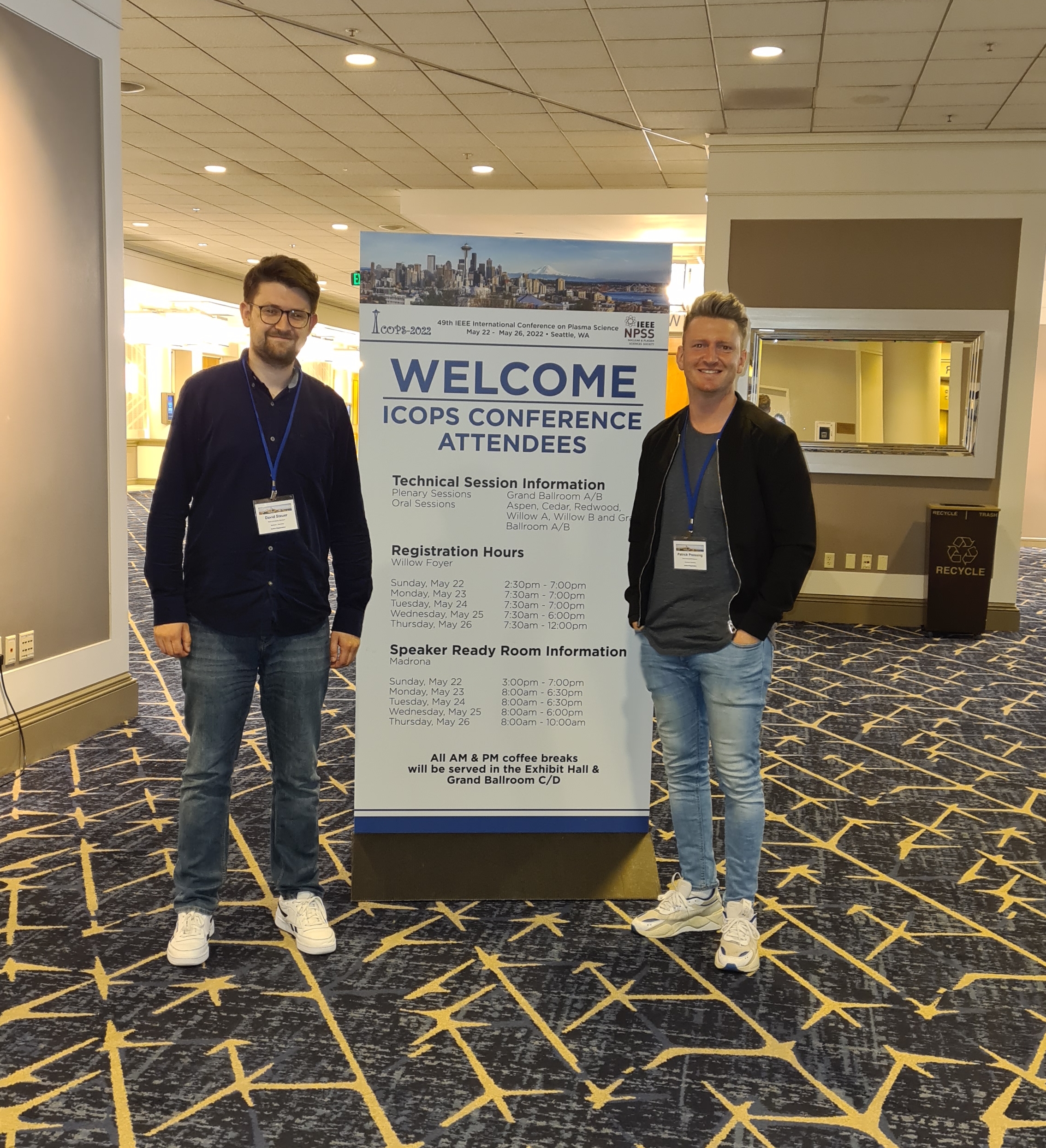
The 49th International Conference on Plasma Science (ICOPS) was held in Seattle from May 22 through May 26. It was one of the first conferences since the beginning of the COVID pandemic situation that was organized as a hybrid conference and partly held on site. It was nice to be back at a live conference getting in touch face to face with other researchers. More than 350 on site attendees visited the conference and more than 150 researchers joined the conference virtually. The conference venue was the Sheraton Grand Seattle located in Seattle Downtown. The scientific program reached out to wide varieties in the field of plasma physics covering topics such as basic phenomena in high temperature fusion plasmas or low temperature plasma jets up to the applications of different sources as for example in medicine, agriculture or for environmental purposes.
Beside the scientific program there were lots of things to discover around the area such as strolling at the famous Pike Place Market or going up the Space Needle to get a great view over the city and the 4392m high volcano Mount Rainier, if it does not hide itself in dense clouds. During the conference a spontaneous group event took place, exploring the night life of Seattle together with around 30 other researchers and the conference was eventually closed with a nice banquet.
Patrick Preissing, project B2